Coater/developer
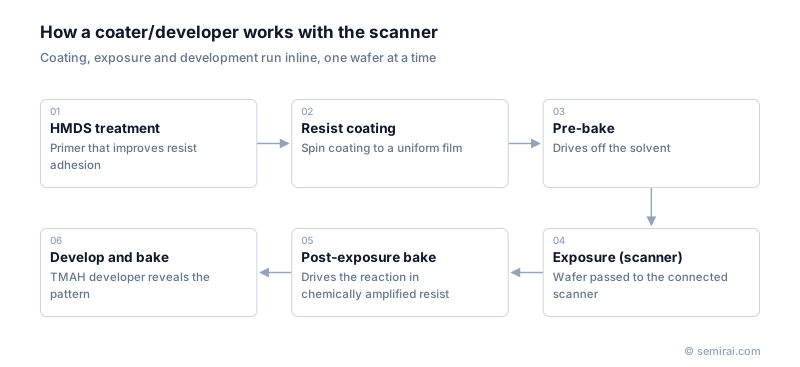
A coater/developer, also called a track, is the tool that coats wafers with photoresist, bakes them, hands them to the lithography scanner for exposure, and then develops the pattern. It is connected directly to the scanner so that wafers flow through all of these steps without leaving the system.
Also called: Track, lithography track
Diagram
What it does
Before exposure, the wafer is treated with HMDS so that the resist sticks, coated with resist by spinning, and baked to remove the solvent. After the scanner exposes it, the wafer is baked again (post-exposure bake), which drives the chemical reaction in chemically amplified resists, and then developed with a TMAH solution to reveal the pattern.
Tokyo Electron notes that coating, exposure and development are often performed inline on one integrated system, which requires high reliability and precise control.
EUV and high-NA EUV
EUV lithography uses the same coat, expose and develop sequence, but its thinner resists and smaller features make uniform coating and development even more critical. Tokyo Electron's current platform is the CLEAN TRACK LITHIUS Pro DICE for 300 mm wafers, designed for EUV processes including high-NA EUV.
Japanese companies involved
- Tokyo Electron says it holds about 90% of the coater/developer market and almost 100% for high-NA EUV processes, which makes this one of the clearest cases of a Japanese company controlling a process step.
- Each EUV scanner works together with a coater/developer, so Tokyo Electron's share means Japanese track tools sit next to most leading-edge lithography lines.
- Tokyo Electron (TEL) · Coat/develop, etch and deposition equipment
- SCREEN Holdings · Wafer cleaning, coat/develop and inspection equipment
Related pages
Sources
Last updated: October 22, 2026