ABF (Ajinomoto Build-up Film)
ABF (Ajinomoto Build-up Film) is the insulating film used to build the fine wiring layers of package substrates for high-performance processors. It is made by Ajinomoto, a Japanese food and amino-acid company.
Also called: ABF film, build-up film
Diagram
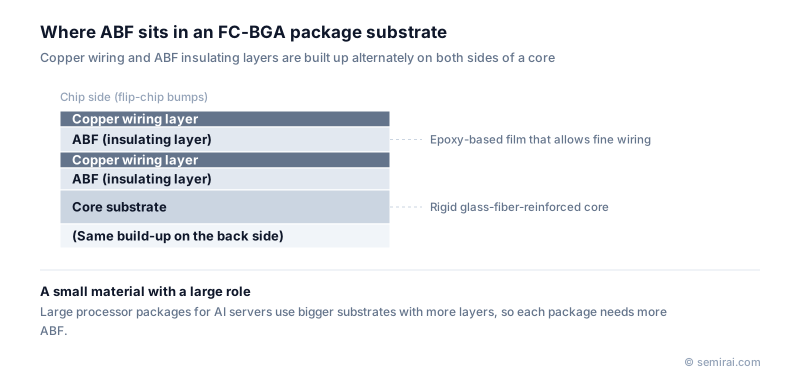
How ABF is used
A package substrate connects a chip to the circuit board. In an FC-BGA (flip-chip ball grid array) substrate, a rigid core is covered on both sides with alternating layers of copper wiring and insulating film. ABF is that insulating film.
Each ABF layer is laminated onto the substrate, small holes (vias) are drilled with a laser, and copper wiring is plated on top. Repeating this builds up the many wiring layers that fan out the thousands of connections of a large processor.
Origin
ABF grew out of Ajinomoto's chemistry know-how from amino-acid production. Ajinomoto says the film was first adopted by a major semiconductor manufacturer in 1999 and has since become the product of choice for nearly all high-performance CPUs.
Why it matters now
AI accelerators and server processors use very large packages, often combining several chips, so their substrates are bigger and have more layers. Each such package needs more ABF, which ties ABF demand to AI server shipments.
Japanese companies involved
- Ajinomoto, the maker of ABF, is a Japanese company, and two of the main substrate makers that use it, IBIDEN and Shinko Electric, are also Japanese.
- ABF is one of several packaging materials where Japanese suppliers are strong, alongside the molding compounds and die-bonding films made by Resonac.
- Ajinomoto · ABF insulating film for package substrates
- IBIDEN · IC package substrates (FC-BGA)
- Shinko Electric Industries · FC-BGA package substrates and lead frames
Related pages
Sources
Last updated: October 22, 2026