Gallium and Germanium Export Controls
Gallium and germanium export controls are the measures China introduced in August 2023 requiring a licence to export gallium, germanium and their compounds, together with later tightening such as a December 2024 ban on exports to the United States. China produces most of the world's primary supply of both elements, so buyers have been working to diversify sources.
Also called: China's gallium and germanium export restrictions
Diagram
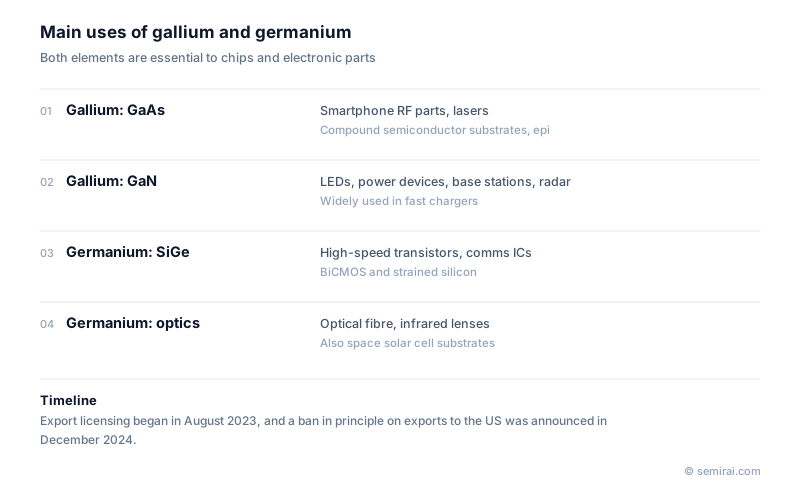
Why the two elements matter
Gallium is the base of the compound semiconductors gallium arsenide (GaAs) and gallium nitride (GaN). GaAs is used in RF power amplifiers in smartphones and in lasers; GaN in blue and white LEDs, fast chargers and other power devices, and RF parts for base stations and radar. Gallium oxide, a candidate for future power devices, also depends on it.
Germanium is used in optical fibre, infrared lenses, silicon-germanium (SiGe) high-speed transistors and substrates for space solar cells. Both elements are mainly recovered as by-products: gallium from alumina refining of bauxite and germanium from zinc refining and coal ash. Because China refines aluminium and zinc on a very large scale and built low-cost recovery, it came to dominate primary production.
The measures and their effect
China's Ministry of Commerce announced the licensing requirement in July 2023, and it took effect on 1 August 2023. In December 2024 it announced that exports of gallium, germanium and some other materials to the United States would in principle not be permitted. The move was widely seen as a response to US controls on advanced chips.
Prices outside China rose after the announcements. Users have been building inventory, expanding recycling of scrap, and restarting or starting production outside China. The details have been revised since they were introduced, so the current status should always be checked against the latest announcements.
Japanese companies involved
- Sumitomo Electric Industries makes GaAs substrates for RF and optical devices, a business that depends on a stable supply of gallium.
- Japan treats critical minerals as an economic security issue and supports stockpiling and recovery of gallium from manufacturing scrap.
- Sumitomo Electric Industries (compound semiconductors) · SiC epitaxial wafers and GaAs and InP substrates
- JX Advanced Metals · Sputtering targets and high-purity metals
FAQ
Can gallium be recycled?
Yes. A large share of gallium waste from GaAs wafer and device production can be collected and refined again, and recycling of this new scrap is an important secondary source. Recovery from end-of-life electronics is much harder because the gallium content is tiny.
Could production outside China grow quickly?
Only gradually. Recovery plants have to be built next to existing alumina or zinc refineries, purification to semiconductor grade takes time to qualify, and producers outside China closed in the past because they could not compete on cost.
Related pages
- Semiconductor Export Controls
- Gallium Arsenide (GaAs)
- Gallium Nitride (GaN)
- Compound semiconductor wafers
- Sumitomo Electric Industries (compound semiconductors) GaN substrates
- Resonac InP epitaxial wafers
- Shin-Etsu Chemical QST® substrate
- Sumitomo Chemical Compound semiconductor epitaxial wafers (GaAs, InP)
Sources
Last updated: November 12, 2026