Semiconductor Export Controls
Semiconductor export controls are government measures that restrict the export of advanced chips, manufacturing equipment, software and know-how for national security and foreign policy reasons. The most far-reaching are the rules the United States has applied to China since October 2022, which Japan and the Netherlands followed with controls of their own.
Also called: chip export controls, export restrictions on semiconductors
Diagram
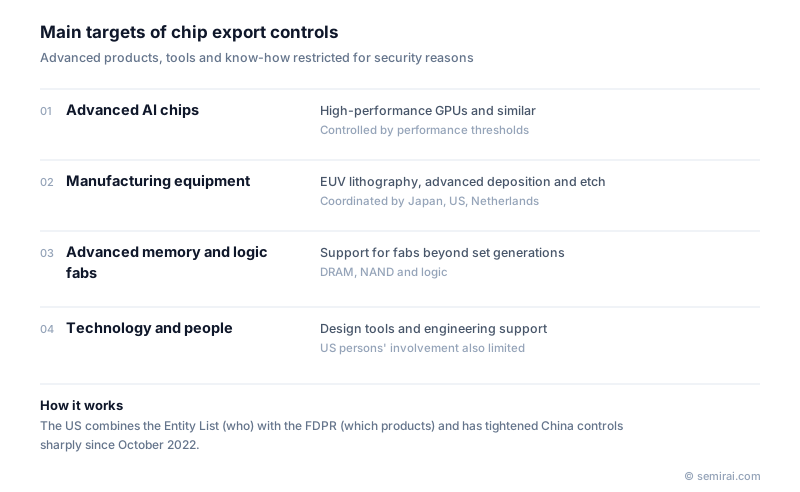
What the US rules cover
The October 2022 rules, issued by the Commerce Department's Bureau of Industry and Security (BIS) under the Export Administration Regulations (EAR), targeted three things: high-performance AI chips and the supercomputers built from them, the equipment needed to make advanced chips, and support for advanced fabs in China. For the fab rules, the thresholds were logic at 16/14 nm or below using non-planar transistors such as FinFET or gate-all-around, DRAM at a half-pitch of 18 nm or less, and NAND with 128 layers or more.
Later revisions in 2023 and 2024 replaced simple chip specifications with performance-based limits for AI chips, added more equipment types and high-bandwidth memory, and widened the list of restricted Chinese companies. US officials describe the approach as a small yard with a high fence: a narrow set of technologies, tightly controlled. Restrictions also cover the activities of US persons who support advanced fabs in China.
How the rules reach beyond the US
Two mechanisms make US controls apply to products made abroad. The de minimis rule covers foreign products that contain more than a set share of controlled US content. The Foreign Direct Product Rule covers foreign products made with US technology, software or equipment, even if they contain no US parts. Combined with the Entity List, which names the companies that need a licence, these rules affect equipment makers and foundries worldwide.
Because the most advanced lithography, deposition and etch tools come from a handful of countries, the US has worked with Japan and the Netherlands to align their national controls. The rules are revised often, so any assessment has to start from the current text.
Japanese companies involved
- In July 2023 Japan amended its Foreign Exchange and Foreign Trade Act rules to require licences for 23 types of advanced chipmaking equipment, including deposition, etching, cleaning and lithography tools, categories in which Tokyo Electron is a major supplier.
- Tokyo Electron (TEL) · Coat/develop, etch and deposition equipment
FAQ
Do export controls ban all chip sales to China?
No. They target advanced products, equipment and know-how above defined thresholds, plus listed end users. Most mature-node chips and much older equipment can still be shipped, although licences may be needed depending on the item and the buyer.
Why do chip export controls change so often?
Thresholds based on technology are overtaken quickly, and companies redesign products to stay below them. Governments therefore revise performance limits, equipment lists and entity lists regularly, which is why exporters track each new rule closely.
Related pages
Sources
Industry and supply chain terms
Last updated: November 2, 2026