PFAS Regulation
PFAS regulation refers to restrictions on making and using per- and polyfluoroalkyl substances (PFAS), a large family of organofluorine compounds with very strong carbon-fluorine bonds. Because they hardly break down and persist in the environment and the body, PFAS are called forever chemicals. Semiconductor manufacturing relies on them in many materials, so the rules matter to the industry.
Also called: forever chemicals regulation, per- and polyfluoroalkyl substances
Diagram
Where regulation stands
The best-known PFAS, PFOS and PFOA, are already banned or severely restricted under the Stockholm Convention on persistent organic pollutants. In 2023 the European Chemicals Agency (ECHA) published a proposal, prepared by five European countries, to restrict around ten thousand PFAS as a group, and it remains under discussion.
In the United States the Environmental Protection Agency (EPA) has introduced reporting requirements and drinking water limits, and 3M announced it would stop making PFAS by the end of 2025. Definitions and scope differ between countries and continue to change, so whether a given material counts as PFAS depends on the rule in question.
How chipmaking depends on PFAS
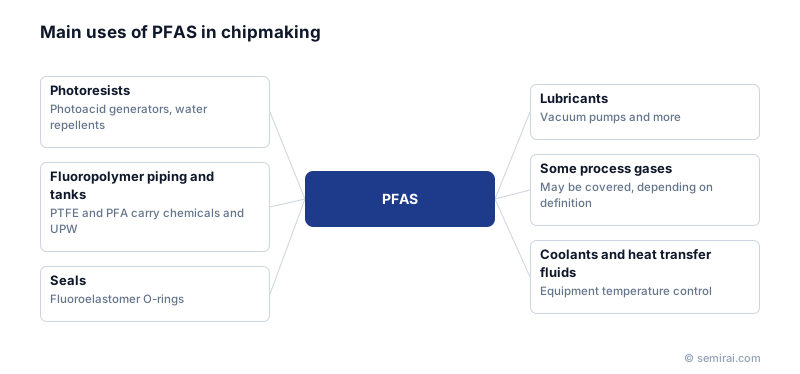
Fluorinated compounds appear throughout a fab. Chemically amplified photoresists use them in photoacid generators and in water-repellent top coats and additives. Pipes, tanks and fittings that carry ultra-pure water and process chemicals are made of fluoropolymers such as PTFE and PFA. Vacuum and wet equipment rely on fluoroelastomer O-rings, vacuum pumps on fluorinated lubricants, and temperature control systems on fluorinated heat transfer fluids. Some process gases may also fall under broad definitions.
Few alternatives combine the same purity and chemical resistance. Industry groups have asked for exemptions for essential uses and long transition periods, while material suppliers and research centres such as imec are developing PFAS-free resists and components.
Japanese companies involved
- Daikin Industries and AGC are major producers of fluoropolymers used in fab piping, containers and seals, materials directly affected by how PFAS is defined.
- Daikin Industries · Etching gases, fluoropolymers and fluoroelastomers
- AGC · EUV mask blanks and glass materials
- JSR · Photoresists and semiconductor materials
- Tokyo Ohka Kogyo (TOK) · Photoresists and high-purity process chemicals
- Shin-Etsu Chemical · Silicon wafers, photoresists and photomask blanks
FAQ
Will PFAS rules stop chip production?
Not in the short term. Proposals discuss exemptions and transition periods for essential uses that cannot yet be replaced. But if broad restrictions are adopted, many materials and parts will need requalification, which takes years in a fab, so suppliers are starting early.
Why are fluoropolymers like PTFE hard to replace in fabs?
They resist almost every acid, base and solvent, release very few particles or metal ions into ultra-pure liquids and tolerate high temperatures. Alternatives usually fall short on at least one of these, and any contamination can reduce yield.
Related pages
Sources
Industry and supply chain terms
Last updated: November 12, 2026