Wassenaar Arrangement
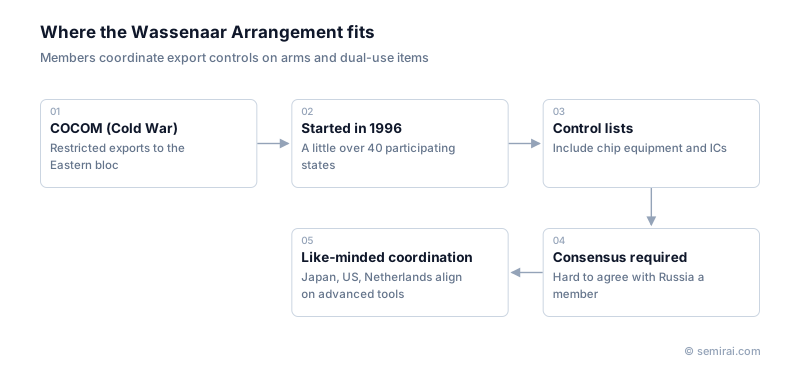
The Wassenaar Arrangement is a multilateral export control regime in which participating states coordinate controls on conventional arms and on dual-use goods and technologies, meaning items with both civil and military uses. It started in 1996 as the successor to COCOM, has a little over forty participants and lists integrated circuits and chipmaking equipment among its controlled items.
Also called: Wassenaar Arrangement on Export Controls for Conventional Arms and Dual-Use Goods and Technologies
Diagram
How it works
COCOM, the Cold War body that restricted exports to the Eastern bloc, was dissolved in 1994. Its successor took its name from Wassenaar, the Dutch town where it was negotiated, and its secretariat is in Vienna. Japan, the United States and most European countries are members.
Participants agree on lists of controlled items and write them into national law. For semiconductors the key section is Category 3 (Electronics) of the dual-use list, which covers integrated circuits above certain performance levels, manufacturing and test equipment, and related materials, software and technology. In Japan the lists appear in orders under the Foreign Exchange and Foreign Trade Act; in the US, in the Commerce Control List of the EAR. Each country still decides for itself whether to grant an export licence.
Why advanced chip controls moved outside it
Decisions are taken by consensus, and Russia is a participant. Since the invasion of Ukraine in 2022, agreeing on new entries has become very difficult. The regime was also designed not to target specific countries, which makes it awkward for the recent goal of keeping advanced technology away from particular destinations.
Controls on the most advanced chipmaking equipment have therefore shifted to coordination among the few countries that build it. After the US rules of October 2022, Japan added 23 types of advanced equipment to its controls in July 2023, and the Netherlands made advanced ArF immersion lithography tools subject to licensing from September 2023. Wassenaar remains the baseline for export control lists, but the newest restrictions are set by smaller groups of countries.
Japanese companies involved
- Exports of controlled equipment by Japanese makers such as Tokyo Electron and Nikon are licensed by METI under the Foreign Exchange and Foreign Trade Act, whose control lists are largely based on the Wassenaar lists.
- Tokyo Electron (TEL) · Coat/develop, etch and deposition equipment
- Nikon · ArF, KrF and i-line lithography systems
FAQ
How does the Wassenaar Arrangement differ from COCOM?
COCOM had named targets: it restricted strategic exports to the communist bloc. Wassenaar does not target any country, members coordinate lists and share information, and former COCOM targets such as Russia have joined it.
Are Japan's 2023 equipment controls based on Wassenaar?
Not directly. Japan's basic control lists come from Wassenaar, but the 23 equipment types added in July 2023 were introduced by a national amendment, coordinated with the US and the Netherlands, without waiting for a Wassenaar consensus.
Related pages
Sources
Industry and supply chain terms
Last updated: November 1, 2026