Multi-Level Cell (MLC, TLC, QLC)
A multi-level cell stores more than one bit in each memory cell by programming it to one of several charge levels. Compared with one bit per cell (SLC), flash memory stores two bits (MLC), three bits (TLC) or four bits (QLC) per cell to fit more capacity into the same silicon at lower cost.
Also called: MLC, TLC, QLC
Diagram
How it works
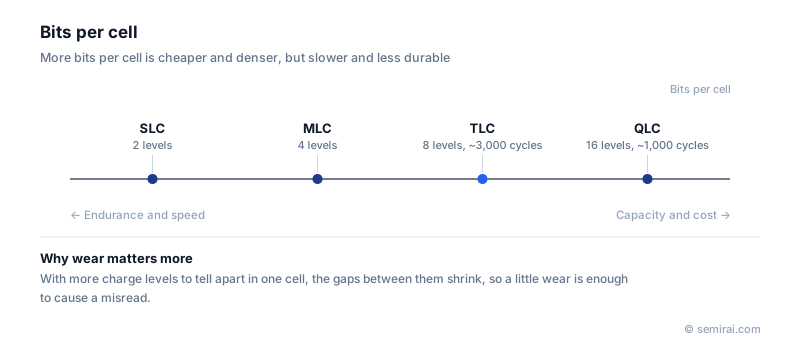
Each flash cell's threshold voltage depends on how much charge it holds. One bit needs two distinguishable levels, two bits need four, three bits need eight and four bits need sixteen. The controller programs a cell to a target level and reads it by comparing the cell against several reference voltages.
With more levels packed into the same voltage window, the margin between neighbouring levels shrinks. Programming has to be done in small steps with verification, and a small loss of charge can turn one level into the next.
The trade-off
More bits per cell lowers cost per bit but slows writing, raises the error rate and reduces the number of program/erase cycles a cell can take. As a rough guide, TLC cells are rated for a few thousand cycles and QLC cells for around a thousand.
Controllers compensate with strong error correction such as LDPC codes, read-retry that adjusts reference voltages as cells age, wear leveling and an SLC cache, in which part of a TLC or QLC drive is written one bit per cell for speed. TLC is the mainstream for consumer and data-centre SSDs, and QLC is used for high-capacity, read-heavy storage.
Japanese companies involved
- Kioxia makes TLC and QLC 3D NAND and SSDs, and its QLC products target high-capacity data-centre storage.
- Kioxia · NAND flash memory and SSDs
FAQ
Why does more bits per cell reduce endurance?
The cell must distinguish more voltage levels with smaller gaps between them, so less wear-induced drift can be tolerated before a level is misread.
Which type should be used where?
SLC suits industrial and high-reliability uses, TLC is the general-purpose standard for SSDs, and QLC is chosen when cost per terabyte matters more than write performance.
Is MLC only used in NAND flash?
Mostly, but the same idea of storing several levels per cell is also studied for emerging memories such as phase-change memory and ReRAM.
Related pages
Sources
Last updated: November 2, 2026