Endurance (Program/Erase Cycles)
Endurance is the number of times a non-volatile memory cell can be written and erased while still meeting its specified performance. For NAND flash it is counted in program/erase (P/E) cycles; beyond that number, cells may fail to program correctly or lose their data sooner.
Also called: P/E cycles, write endurance
Diagram
Why flash wears out
Each program or erase forces electrons through the thin tunnel oxide under a strong electric field. Some of them get stuck in the oxide and create defects. As defects accumulate, the cell's threshold voltage drifts more easily and reads become less reliable.
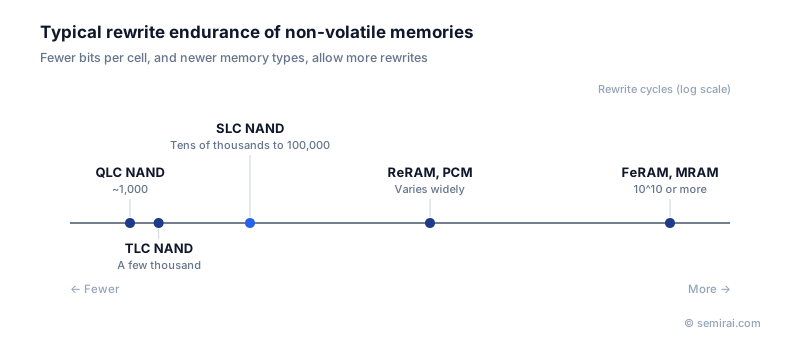
The more bits a cell stores, the less drift it can tolerate. Typical figures are tens of thousands to around 100,000 cycles for SLC, several thousand to ten thousand for MLC, a few thousand for TLC and around a thousand for QLC, though actual ratings vary by generation and product.
Endurance is also why controllers keep a spare area of blocks. When a block's error count grows too large or a program operation fails, the controller retires it and maps in a spare block, so the drive's usable capacity stays the same.
Endurance in newer memories
Endurance is a key selling point for emerging memories. FeRAM and MRAM can be rewritten 10^10 times or more and replace flash where data changes constantly. ReRAM and phase-change memory sit in between.
Endurance and data retention are linked: a cell that has been rewritten many times holds its data for a shorter time, so specifications state both together, for example a retention period after the rated number of cycles.
Japanese companies involved
- Kioxia rates its SSDs for endurance in drive writes per day and publishes material explaining how flash endurance is managed.
- Kioxia · NAND flash memory and SSDs
FAQ
Will a QLC SSD wear out quickly?
Not for typical read-heavy use. The controller, error correction and spare capacity spread the wear, and drives are rated in total bytes written. QLC suits workloads that read much more than they write.
How are endurance and data retention related?
Rewriting damages the cell's insulator, so heavily cycled cells lose charge faster. Retention is therefore specified after a given number of cycles.
Related pages
Sources
Last updated: November 1, 2026