Error Correction Code (ECC)
An error correction code (ECC) adds redundant check bits to data when it is written so that, when the data is read back, bits that have flipped can be located and corrected. Memories use ECC to protect data against soft errors from radiation, cell wear and disturbance between neighbouring cells.
Also called: ECC memory, SECDED, LDPC
Diagram
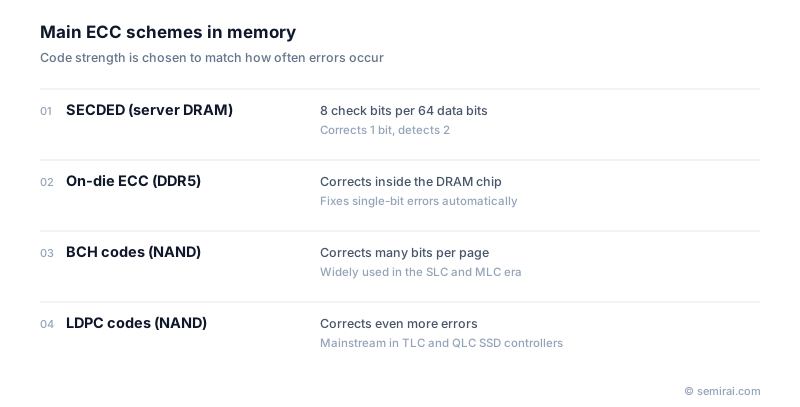
ECC in DRAM
Server memory modules have long used single-error-correct, double-error-detect (SECDED) codes: 8 check bits are stored with every 64 data bits, enough to fix any one-bit error and detect two-bit errors. This is what ECC memory usually means.
DDR5 adds on-die ECC inside each DRAM chip, which silently corrects single-bit errors within the chip. It improves the chip's internal reliability but does not replace module-level ECC, because it does not protect data on the bus or report errors to the system.
ECC in NAND flash
Flash needs much stronger codes. As cells store three or four bits, the voltage levels crowd together and raw error rates rise. SSD controllers therefore use BCH codes or, in current TLC and QLC drives, low-density parity-check (LDPC) codes that correct dozens of bits per page or more.
How many errors the controller can correct sets how far cells can wear and how long data can sit unpowered before it becomes unreadable, so ECC strength is central to SSD endurance and retention ratings.
ECC works together with other controller techniques. Read-retry shifts the reference voltages to recover pages that fail decoding, and data whose error count is rising can be rewritten to a fresh block before it becomes uncorrectable.
Japanese companies involved
- Kioxia, a major NAND flash and SSD maker, designs the error correction used in its SSD controllers.
- Kioxia · NAND flash memory and SSDs
FAQ
If DDR5 has on-die ECC, is ECC memory still needed?
For servers, yes. On-die ECC corrects errors inside each chip but does not cover the path to the processor or report errors, which module-level ECC does.
Why does NAND need stronger ECC than DRAM?
Multi-level flash cells have very small margins between levels and drift with wear and time, so they produce far more raw bit errors than DRAM.
Related pages
Sources
Last updated: November 1, 2026