Wear Leveling
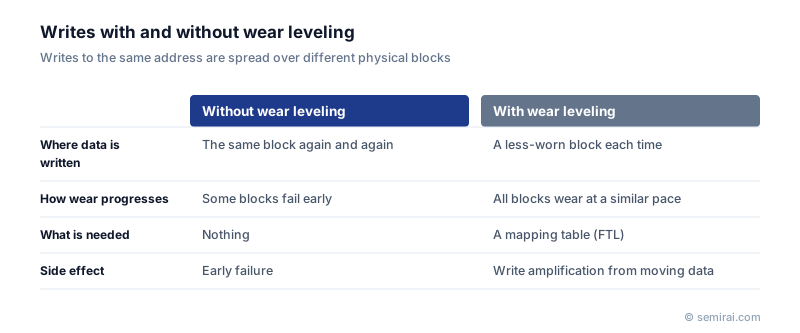
Wear leveling is the technique of spreading writes across all the blocks of a flash memory so that every block wears at about the same rate. Flash cells can be rewritten only a limited number of times, and without wear leveling the blocks holding frequently changed data would fail long before the rest.
Diagram
How the controller does it
SSDs, memory cards and phone storage contain a controller with a flash translation layer (FTL), a table that maps the logical addresses the operating system uses to physical blocks in the flash. When the host rewrites the same logical address, the controller writes the new data to a fresh block and updates the table, leaving the old copy to be erased later by garbage collection.
Dynamic wear leveling sends new writes to the least-worn free blocks. Static wear leveling also moves data that rarely changes, so that the blocks it occupies take their share of rewrites.
Wear leveling also interacts with the file system. Commands such as TRIM tell the controller which logical blocks no longer hold valid data, so it can skip copying them during garbage collection and avoid unnecessary wear.
The cost
Moving data creates writes the host never asked for, known as write amplification, which itself consumes endurance. Drive lifetime ratings such as total bytes written (TBW) and drive writes per day (DWPD) depend on cell endurance, the efficiency of wear leveling and garbage collection, and the spare capacity kept in reserve (over-provisioning). QLC drives, whose cells tolerate fewer rewrites, depend on this control even more.
Japanese companies involved
- Kioxia publishes technical material on SSD structure, operation and endurance, including wear leveling, and builds it into its SSD controllers.
- Kioxia · NAND flash memory and SSDs
FAQ
Where does wear leveling happen?
In the controller inside the SSD, memory card or embedded storage device. The operating system does not need to manage it.
What is the difference between dynamic and static wear leveling?
Dynamic wear leveling only redirects new writes to less-worn blocks. Static wear leveling also relocates rarely changed data so that every block takes part in rewrites.
Related pages
Sources
Last updated: November 2, 2026