Flash Memory
Flash memory is non-volatile memory that keeps data without power and can be electrically erased in large blocks at once, in a flash, which gave it its name. It stores data as charge in a floating gate or a charge-trap layer and comes in two main types, NAND and NOR, named after how the cells are connected.
Diagram
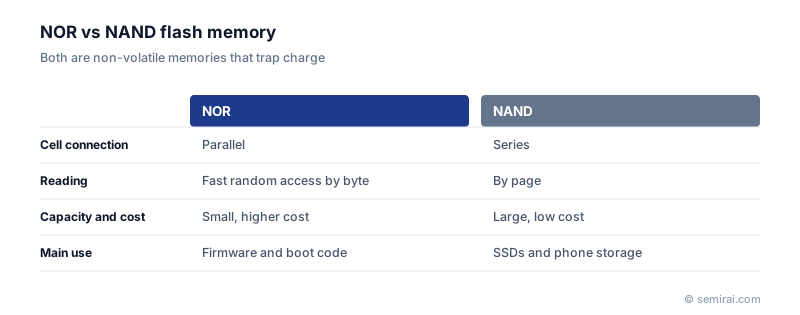
NAND and NOR
NAND flash connects cells in series in strings, which makes each cell small and suits high-capacity storage read and written in pages: SSDs, smartphones, USB drives and memory cards. NOR flash connects cells in parallel, so any byte can be read quickly and code can be executed directly from it; it holds firmware and boot code in microcontrollers, cars and network equipment.
Both erase in blocks rather than byte by byte, which is why flash needs a controller or a file system that manages where data is written.
Strengths and limits
Writing and erasing push electrons through a thin insulator with a high electric field. This is slower than writing DRAM and slowly damages the insulator, so each cell can be rewritten only a limited number of times. Multi-level cells and 3D stacking have raised capacity and lowered cost, while error correction and wear leveling keep the drives reliable.
Japanese companies involved
- Flash memory was invented by Fujio Masuoka at Toshiba in the 1980s. Toshiba's memory business became Kioxia, one of the world's largest NAND makers.
- Renesas Electronics builds embedded flash into its microcontrollers.
- Renesas Electronics · Microcontrollers, automotive SoCs, analog and power chips
- Kioxia · NAND flash memory and SSDs
FAQ
What is the difference between NOR and NAND flash?
NOR is fast to read at random and holds program code; NAND is denser and cheaper per bit and holds bulk data.
Why does flash wear out?
Each program and erase forces electrons through the tunnel oxide, gradually creating defects that trap charge and shift the cell's threshold voltage until it can no longer be read reliably.
How do floating gate and charge trap cells differ?
A floating gate stores charge in a conductive layer; a charge trap stores it in an insulating nitride film. Most 3D NAND uses charge trap cells.
Related pages
Sources
Last updated: November 2, 2026