Transistor Density (MTr/mm²)
Transistor density measures how many transistors fit in one square millimetre of silicon, usually expressed in millions of transistors per square millimetre (MTr/mm²). Now that node names no longer describe real dimensions, it is widely used, together with contacted gate pitch and metal pitch, to compare how dense different processes are.
Also called: logic density, MTr/mm2
Diagram
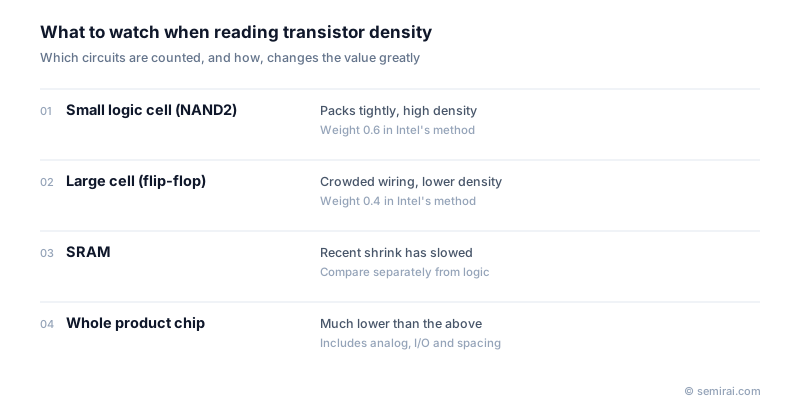
Why the number depends on how you count
The same process gives very different densities depending on which circuits are measured. A simple cell packed tightly with transistors is several times denser than a complex cell with crowded wiring. To make processes comparable, Intel's Mark Bohr proposed a method in 2017 that takes the density of a small logic cell, a two-input NAND gate (NAND2), and a large one, a scan flip-flop, and weights them 60% and 40%. The method became a common yardstick in industry comparisons.
Estimates made this way put 5nm-class processes at well over 100 million transistors per square millimetre. Because companies do not always publish the figure, many quoted numbers are third-party estimates.
Why real chips are less dense
A finished product is considerably less dense than such process figures. Chips contain SRAM, analog circuits and input/output circuits, all of which differ in density from standard logic, and they need space for wiring, power distribution and design margins. SRAM in particular has scaled much more slowly than logic in recent generations. When comparing published densities, it is worth checking which method was used and whether the figure refers to logic or SRAM.
Japanese companies involved
- Rapidus, which is developing a 2nm process in Hokkaido, is entering a generation where density gains depend as much on new structures such as nanosheets and backside power as on smaller dimensions.
- Rapidus · Leading-edge logic foundry (2 nm, in development)
FAQ
Why is a product chip less dense than the process figure?
The process figure is calculated from compact logic cells. A real chip also contains SRAM, analog blocks and I/O circuits, plus space for routing and power, so its average density across the whole die is lower.
How does transistor density relate to Moore's Law?
Moore's Law is the observation that the number of transistors on a chip doubles roughly every two years. Transistor density tracks that progress per unit area. As simple shrinking slows, density now rises through structural changes such as nanosheets, backside power and stacking, as well as through smaller pitches.
Why is SRAM density reported separately?
SRAM cells have stopped shrinking as quickly as logic cells, so a single blended number would hide the difference. Manufacturers usually quote the area of a single SRAM bit cell, in square micrometres, as a separate metric.
Related pages
Sources
Last updated: November 1, 2026