ADC / DAC (Analog-to-Digital and Digital-to-Analog Converters)
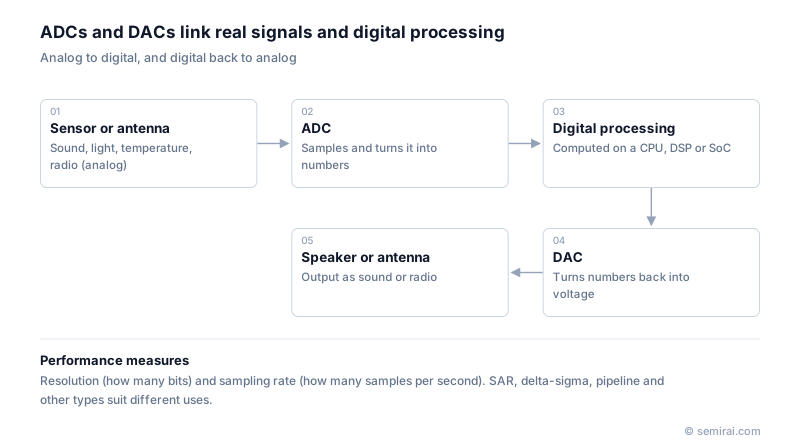
An analog-to-digital converter (ADC) turns a continuous analog signal into digital numbers, and a digital-to-analog converter (DAC) does the reverse. ADCs let digital circuits process real-world signals such as sound, light, temperature and radio waves, and DACs turn digital data back into sound or radio signals. Together they sit at the input and output of almost every electronic system.
Also called: data converter, A/D converter, D/A converter
Diagram
Sampling and quantisation
Analog-to-digital conversion has two parts. Sampling measures the signal at regular time intervals, and quantisation rounds each measurement to one of a fixed number of levels. The two key specifications follow from this: resolution, the number of bits per sample (12 bits gives 4,096 levels), and sampling rate, the number of samples per second. By the Nyquist criterion, the sampling rate must be more than twice the highest frequency in the signal, or high frequencies fold back as false signals (aliasing).
Real converters are also judged on noise, linearity, effective number of bits (ENOB) and power consumption.
Main ADC architectures
Different architectures trade speed against resolution. Delta-sigma (ΔΣ) converters oversample and filter to reach very high resolution at low to moderate speed, suited to audio and precision measurement. Successive-approximation (SAR) converters use one comparator and a binary search, balancing speed, resolution and power, which makes them common in microcontrollers and sensors. Pipeline converters reach high speeds with good resolution for communications and imaging, and flash converters compare the input with many levels at once for the highest speed at low resolution.
Data converters are central to analog and mixed-signal semiconductors, an area where Analog Devices and Texas Instruments are major suppliers.
Japanese companies involved
- Renesas Electronics integrates ADCs and DACs into its microcontrollers and also offers stand-alone data converters.
- Asahi Kasei Microdevices is known for audio ADCs and DACs, and ROHM supplies audio DACs and other analog ICs.
- Renesas Electronics · Microcontrollers, automotive SoCs, analog and power chips
- ROHM · SiC and silicon power devices, analog ICs
FAQ
What do resolution and sampling rate mean?
Resolution is how finely the converter divides the input range, given in bits; each extra bit doubles the number of levels. Sampling rate is how many conversions are made per second. A good choice depends on the signal: audio needs high resolution at modest speed, while radio needs very high speed.
Where are ADCs and DACs used?
In smartphones for audio, cameras and radio, in digital audio, test instruments, automotive sensors and medical equipment. Wireless base stations and radar need very fast, high-resolution converters to digitise radio signals directly.
Related pages
Sources
Last updated: November 2, 2026