Analog Circuit (Analog IC)
An analog circuit treats voltage and current as continuously varying quantities, rather than as the 0s and 1s of digital logic. It amplifies, converts and controls real-world signals such as temperature, sound, light, radio waves and electrical power. An integrated circuit built from such circuits is called an analog IC, and almost every electronic device contains several.
Also called: analog IC, analog semiconductor
Diagram
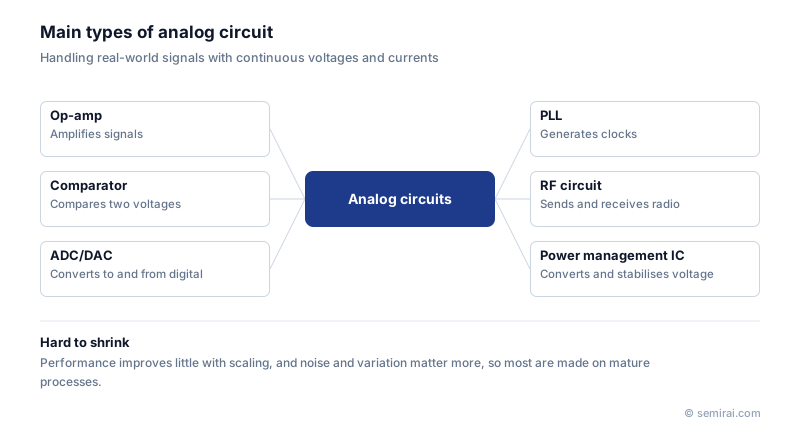
Main types of analog circuit
Common building blocks include the operational amplifier (op-amp), which amplifies signals; the comparator, which decides which of two voltages is larger; analog-to-digital and digital-to-analog converters (ADCs and DACs), which link analog signals with digital processing; phase-locked loops (PLLs), which generate clocks; RF circuits, which transmit and receive radio signals; and power management ICs (PMICs) such as LDO regulators and DC-DC converters, which convert and stabilise supply voltages.
In a typical system, analog circuits read the sensors and deliver power from the battery or mains to every other circuit, while the digital part does the computing in between.
Why analog ICs use mature processes
Unlike digital logic, analog circuits gain little from shrinking transistors. Smaller transistors run at lower supply voltages, which reduces the signal swing available, and their mismatch and noise have a larger effect on precision. Many analog ICs are therefore made on mature processes, roughly from 180nm to 40nm, or on BCD processes that combine bipolar, CMOS and high-voltage DMOS devices for power management.
Analog design also depends heavily on the designer. Circuits are tuned with SPICE simulation, and the placement and wiring of devices are often drawn by hand to control matching and parasitics. Experienced analog designers are in short supply worldwide. Major suppliers include Texas Instruments, Analog Devices, Infineon and STMicroelectronics.
Japanese companies involved
- Renesas Electronics supplies analog and power management ICs alongside its microcontrollers, a portfolio expanded through its acquisitions of Intersil and IDT.
- ROHM makes op-amps, comparators, power management ICs and other analog ICs, and Nisshinbo Micro Devices and ABLIC also specialise in analog and power ICs.
- Renesas Electronics · Microcontrollers, automotive SoCs, analog and power chips
- ROHM · SiC and silicon power devices, analog ICs
FAQ
What is the difference between analog and digital circuits?
Analog circuits handle continuously varying voltages and currents, for example amplifying a sensor signal or regulating a supply voltage. Digital circuits represent information as 0s and 1s and do computation and storage. Most products use analog circuits to capture real signals, an ADC to digitise them and digital circuits to process them.
Why are analog ICs rarely made on leading-edge processes?
Leading-edge transistors run at low voltage, which limits signal swing and the voltages a chip can handle, and their variation and noise hurt precision. Mature processes are cheaper and offer higher-voltage and better-matched devices, so most analog products stay there.
Related pages
Sources
Last updated: November 13, 2026