Average Selling Price (ASP)
Average selling price (ASP) is the average price per unit sold, calculated by dividing revenue for a period by the number of units shipped. In the semiconductor industry it is used to split changes in revenue into volume and price, and in DRAM and NAND flash it moves sharply with supply and demand, often deciding a company's results.
Also called: ASP
Diagram
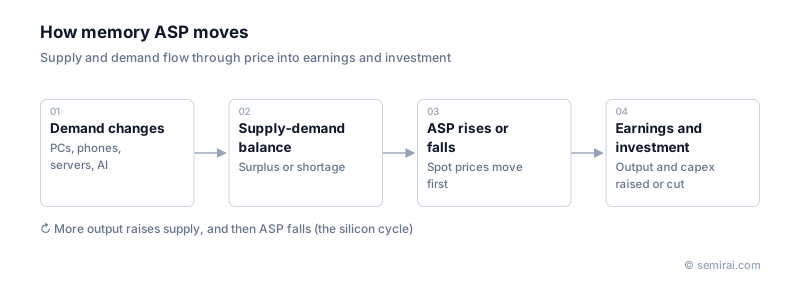
Why ASP matters most in memory
DRAM and NAND flash are built to industry standards, so products from different makers are hard to tell apart and prices are set largely by the balance of supply and demand. When demand runs ahead of supply, ASP rises quickly; when new capacity creates a surplus, it falls just as fast.
Memory is usually measured per bit rather than per chip, because chip capacities keep rising. Memory makers therefore report two numbers each quarter: the change in bit shipments and the change in ASP. Revenue growth is roughly the product of the two, so analysts read them together to see whether a company is gaining volume, price or both.
Product mix and price types
ASP also changes with the mix of products. When expensive products such as HBM make up a larger share of sales, the overall DRAM ASP rises even if the price of each product stays the same. This is why a company can report rising ASP in a weak market.
Memory has two kinds of price. Contract prices are negotiated, usually monthly or quarterly, between memory makers and large customers such as PC and server makers. Spot prices are set daily in trading among distributors and react faster to changes in demand, so they are watched as a leading indicator of contract prices. Swings in ASP are closely tied to the silicon cycle and to decisions on capital spending.
Japanese companies involved
- Kioxia, the Japanese NAND flash maker, reports quarterly changes in bit shipments and ASP in its results, as other memory makers do.
- Kioxia · NAND flash memory and SSDs
FAQ
Is a rising ASP always good news?
Not always. ASP can rise because the mix shifted to premium products while volumes fall, or because prices jumped during a shortage that customers then work through with inventory. Margins, bit shipments and customer inventory all need to be read with it.
Is ASP used outside memory?
Yes. Logic, analog and foundry businesses also track ASP, for example revenue per wafer at a foundry. Prices there are less volatile than in memory because products are more customised and contracts run longer.
Related pages
Sources
Last updated: November 1, 2026