Economic Security Promotion Act (Japan)
The Economic Security Promotion Act is a Japanese law enacted in May 2022 to protect national security through economic measures. It rests on four pillars: securing supply of critical goods, screening critical infrastructure, supporting advanced technology development and keeping sensitive patent applications unpublished. Semiconductors were designated a specified critical product in December 2022.
Also called: Economic Security Act, ESPA
Diagram
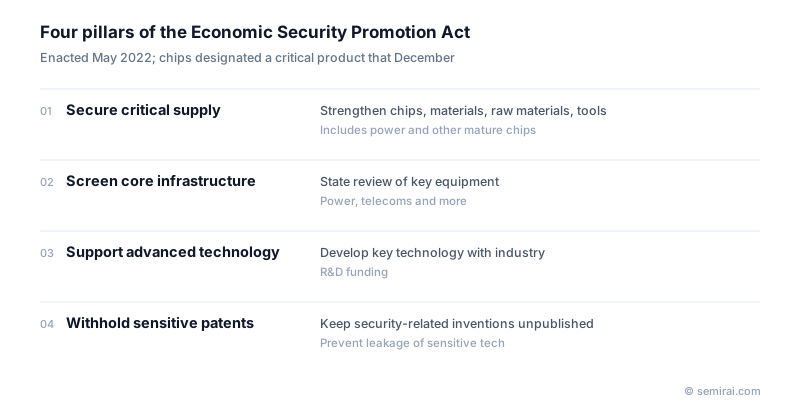
The four pillars
The first pillar lets the government designate goods essential to daily life and the economy as specified critical products and support the companies that produce or stockpile them. The second requires operators of core infrastructure such as electricity, telecommunications and finance to have important equipment introductions screened in advance. The third funds the development of key technologies such as AI and quantum through public-private programmes. The fourth allows the publication of patent applications for sensitive inventions to be withheld.
The aim is to prepare for supply chain disruption, technology leakage and attacks on critical infrastructure, risks that semiconductors touch on in almost every case.
What it supports in semiconductors
Support for semiconductors under the act focuses on conventional devices such as power semiconductors, microcontrollers and analog chips, together with manufacturing equipment, parts and materials such as photoresists and silicon wafers, and the stable supply of raw materials. Critical minerals, batteries and permanent magnets are also designated, so much of the chip supply chain falls under the act in some way.
The large subsidies for leading-edge fabs, such as the TSMC-majority JASM fab in Kumamoto and Rapidus in Hokkaido, come mainly from other schemes: the amended 5G Promotion Act and funds managed by NEDO, Japan's New Energy and Industrial Technology Development Organization. Together these form Japan's chip policy, which, like the US CHIPS Act and the European Chips Act, combines subsidies for domestic production with export controls against technology leakage.
Japanese companies involved
- Support plans certified under the act include investment in power semiconductors, silicon wafers and chip materials by Japanese makers.
- JASM and Rapidus, the two leading-edge fab projects, are funded mainly under the 5G Promotion Act and NEDO funds rather than this act.
- JASM (TSMC Kumamoto) · Foundry fab operated by a TSMC-majority joint venture
- Rapidus · Leading-edge logic foundry (2 nm, in development)
- Renesas Electronics · Microcontrollers, automotive SoCs, analog and power chips
- ROHM · SiC and silicon power devices, analog ICs
- Shin-Etsu Chemical · Silicon wafers, photoresists and photomask blanks
- SUMCO · Silicon wafers
- JSR · Photoresists and semiconductor materials
FAQ
Was TSMC's Kumamoto subsidy granted under this act?
Mainly no. Support for JASM and Rapidus is provided through the amended 5G Promotion Act and NEDO funds. The Economic Security Promotion Act mostly supports supply capacity for conventional chips, equipment, parts and materials.
What does being a specified critical product mean for a company?
A company that plans to expand production or secure supply of a designated product can submit a plan to the responsible ministry. If the plan is certified, the company becomes eligible for grants or other support, in return for commitments such as continued supply in an emergency.
Related pages
Sources
Industry and supply chain terms
Last updated: November 2, 2026