Foreign Direct Product Rule (FDPR)
The Foreign Direct Product Rule (FDPR) is a provision of the US Export Administration Regulations (EAR) that brings foreign-made items under US export control when they are the direct product of US technology or software, or are made in a plant whose major equipment is itself a product of US technology. It lets the US control goods that contain no US parts at all.
Also called: FDP rule, foreign-produced direct product rule
Diagram
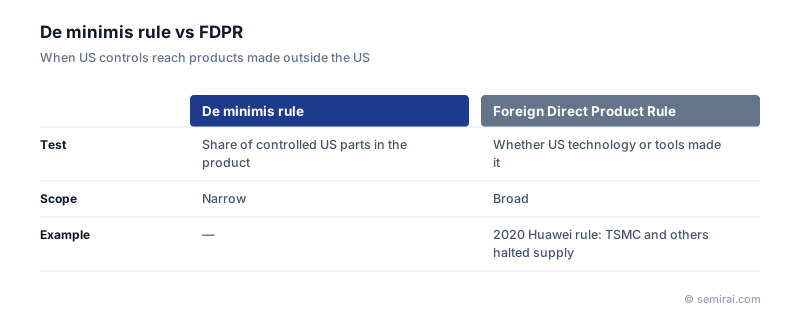
FDPR vs the de minimis rule
The US has two main tools for controlling products made abroad. The de minimis rule looks at content: a foreign product becomes subject to the EAR if the value of controlled US-origin parts exceeds a threshold, generally 25% and 10% for some destinations. The FDPR looks at how the product was made: if US technology, software or equipment was used in the production process, the result can be controlled, whatever its parts list.
This makes the FDPR especially powerful in semiconductors. Chip design depends on electronic design automation (EDA) software, and almost every advanced fab uses some equipment built with US technology. As a result, nearly every leading-edge chip in the world can fall within its scope.
How it has been used in semiconductors
The rule became central to chip policy in 2020, when the US applied an FDPR targeted at Huawei. Supplying chips made with US technology or equipment to Huawei now needed a licence, and TSMC and other foundries outside the US stopped manufacturing for Huawei's chip design unit HiSilicon.
The October 2022 rules on advanced computing added FDPR provisions for AI chips and supercomputers, and in December 2024 the US extended it to certain chipmaking equipment made outside the United States. That equipment rule exempted Japan and the Netherlands, which had already introduced comparable national controls. The episode showed both the reach of the rule and the friction it creates with allies whose companies may be affected by a US decision.
Japanese companies involved
- Japanese equipment makers such as Tokyo Electron must check whether their products and production rely on US technology under the FDPR, while also complying with Japan's own controls under the Foreign Exchange and Foreign Trade Act.
- Tokyo Electron (TEL) · Coat/develop, etch and deposition equipment
FAQ
Can a product with no US parts be subject to US export controls?
Yes. Under the FDPR, what matters is whether US technology, software or equipment was used to make the product. A chip made entirely of non-US materials can still be controlled if it was designed with US software or fabricated on US-origin tools, and the relevant rule applies to the destination or buyer.
Is the FDPR one rule or several?
Several. The EAR contains a number of separate foreign direct product rules, each tied to a specific purpose such as listed entities, advanced computing, supercomputers or chipmaking equipment, with its own product scope and destination conditions.
Related pages
Sources
Last updated: November 2, 2026