Fabless, Foundry and IDM
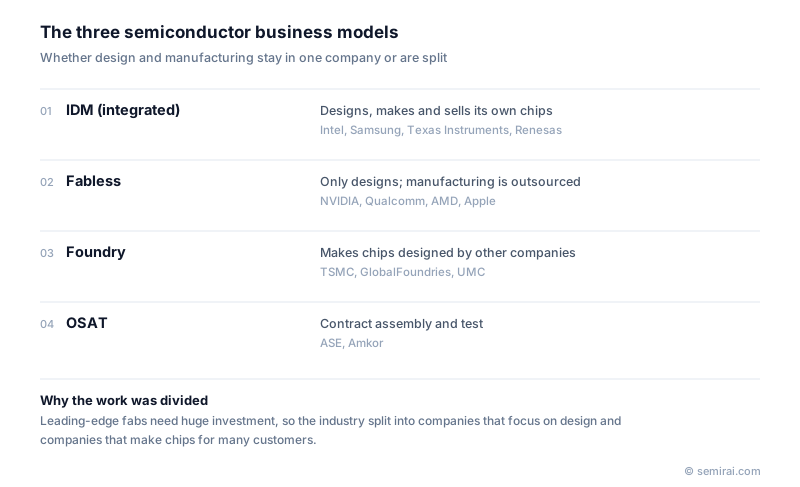
Fabless, foundry and IDM are the three basic business models of the semiconductor industry. An IDM (integrated device manufacturer) designs, manufactures and sells its own chips. A fabless company designs chips but owns no fab and outsources production. A foundry manufactures chips designed by other companies and does not sell products under its own brand.
Also called: semiconductor business models, integrated device manufacturer, pure-play foundry
Diagram
How the division of labour emerged
Until the 1980s almost every chip company was an IDM. As the cost of a leading-edge fab rose, it became hard for any single company to fill one with its own products. TSMC, founded in Taiwan in 1987, was the first pure-play foundry: it made chips only for customers and promised not to compete with them. That made it possible to start a chip company with design skills alone, and the fabless model grew through the 1990s.
The split extends to the back end. Outsourced semiconductor assembly and test (OSAT) companies such as ASE and Amkor package and test chips for fabless firms and IDMs alike, and design is supported by EDA vendors and IP licensors such as Arm.
Typical companies and hybrid models
Memory makers such as Samsung, SK hynix, Micron and Kioxia are IDMs, as are Texas Instruments and Intel's traditional product business. Fabless examples include NVIDIA, AMD, Qualcomm, Broadcom, MediaTek and Apple's chip design group. Major foundries include TSMC, Samsung Foundry, GlobalFoundries, UMC and SMIC.
Many companies sit between the models. Samsung runs a memory IDM and a foundry in the same group, and Intel now offers manufacturing to outside customers through Intel Foundry. Fab-lite companies such as STMicroelectronics, NXP and Renesas keep their own fabs for mature and specialty processes but buy leading-edge logic from foundries. Joint-venture fabs, in which a foundry builds a plant with local partners and customers, are another variant.
Japanese companies involved
- Japan's large chipmakers are mostly IDMs or fab-lite: Kioxia makes its own NAND flash, and Renesas Electronics runs its own fabs while using foundries for advanced logic.
- JASM in Kumamoto is a foundry joint venture majority-owned by TSMC, with Sony Semiconductor Solutions and Denso among its shareholders.
- Rapidus is building a foundry in Hokkaido aimed at 2 nm logic, and Socionext is a fabless designer of custom SoCs.
- Kioxia · NAND flash memory and SSDs
- Renesas Electronics · Microcontrollers, automotive SoCs, analog and power chips
- JASM (TSMC Kumamoto) · Foundry fab operated by a TSMC-majority joint venture
- Sony Semiconductor Solutions · CMOS image sensors
- Rapidus · Leading-edge logic foundry (2 nm, in development)
- Socionext · Fabless custom SoC design
FAQ
What are the advantages of being fabless?
A fabless company avoids the capital cost of fabs, which runs to tens of billions of dollars at the leading edge, and can choose the best available process for each product. The trade-offs are dependence on foundry capacity and pricing, and less control over process details.
Why do IDMs still exist?
For memory, analog, power and sensor chips, the process itself is a main source of product performance, so tight links between design and manufacturing pay off. Owning fabs also secures supply, which matters for automotive and industrial customers with long product lives.
What is a pure-play foundry?
A foundry that makes only customers' designs and sells no chips of its own, so it never competes with its customers. TSMC, UMC and GlobalFoundries are pure-play; Samsung Foundry and Intel Foundry belong to companies that also sell their own chips.
Comparisons
Related pages
Sources
Last updated: November 2, 2026