DRAM (Dynamic Random-Access Memory)
DRAM (dynamic random-access memory) is volatile memory that stores one bit as the presence or absence of charge on a capacitor, selected by a single transistor. Because the charge leaks away, every cell has to be read and rewritten many times a second, which is why the memory is called dynamic.
Also called: dynamic RAM, main memory
Diagram
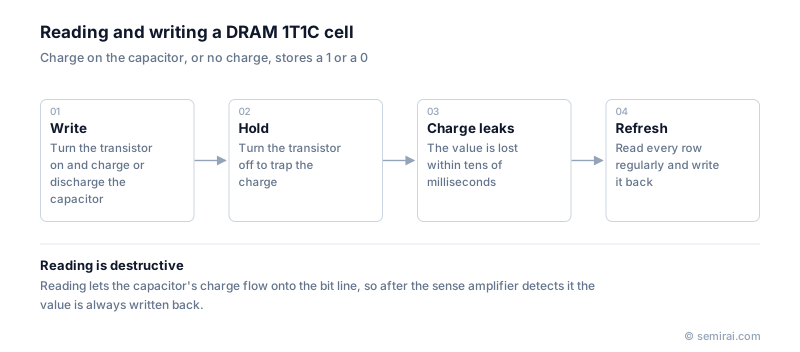
How a DRAM cell works
Each cell is one transistor and one capacitor (1T1C). To write, the word line turns the transistor on and the bit line charges or discharges the capacitor. To read, the transistor is turned on again and a sense amplifier detects the small change the stored charge causes on the bit line. Reading drains the capacitor, so the value is always written back.
The charge leaks through the transistor and the capacitor's insulator within tens of milliseconds, so the memory controller refreshes every row on a fixed schedule. The small, simple cell is what lets DRAM reach high capacity at low cost, and refresh is the price it pays for that.
Where DRAM is used
DRAM is the working memory of PCs and servers (DDR4 and DDR5 modules), smartphones (LPDDR) and graphics cards (GDDR). Stacked vertically and connected with through-silicon vias, it becomes HBM, the high-bandwidth memory placed next to AI accelerators.
Speed is measured as data rate and latency, and each DDR generation raises the data rate while lowering the supply voltage.
Why DRAM is hard to make
Shrinking the cell leaves less room for the capacitor, yet it still has to hold enough charge to be read reliably. Manufacturers therefore build tall cylindrical capacitors with very high aspect ratios, coat them with high-k dielectrics by atomic layer deposition, and use EUV lithography for the most critical layers of the newest generations. Deep etching and conformal deposition are as important to DRAM as lithography.
Japanese companies involved
- Micron Memory Japan makes DRAM at its fab in Hiroshima, one of the few DRAM production sites outside Korea, the United States and China.
- Japanese equipment and materials makers supply many of the deposition, etch, cleaning and lithography steps that DRAM production depends on.
- Micron Memory Japan (Micron Hiroshima) · DRAM fab in Hiroshima (Micron Technology)
FAQ
What is the difference between DRAM and SRAM?
DRAM stores each bit on a capacitor with one transistor, so it is dense and cheap but needs refresh. SRAM uses six transistors per bit, needs no refresh and is faster, but takes far more area, so it is used for on-chip caches rather than main memory.
Does DRAM keep data when power is off?
No. DRAM is volatile: without power the refresh stops and the stored charge leaks away, so the data is lost. Data that must survive power-off is kept in non-volatile memory such as NAND flash.
How is HBM related to DRAM?
HBM is DRAM. Several DRAM dies are thinned, stacked and connected with through-silicon vias on a base die, giving a very wide interface placed next to a processor on the same package.
Comparisons
Related pages
Sources
Last updated: November 2, 2026