Floating Gate
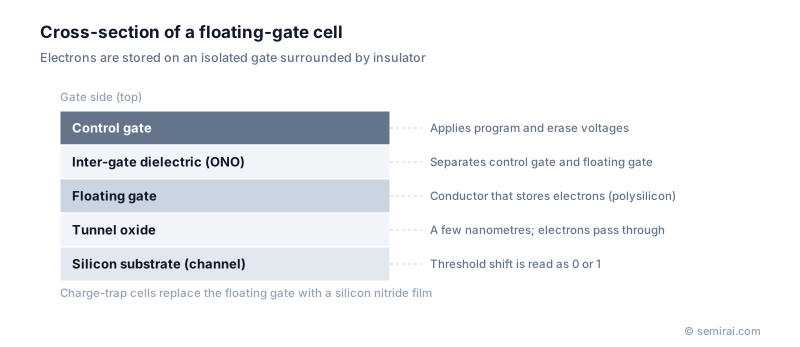
A floating gate is a conductive layer, usually polysilicon, completely surrounded by insulator and connected to nothing, placed between the control gate and the channel of a flash memory transistor. Electrons stored on it change the transistor's threshold voltage, and that shift is read as a 0 or a 1.
Also called: floating-gate transistor
Diagram
How it stores data
To program the cell, a high voltage on the control gate pulls electrons from the channel through a thin tunnel oxide onto the floating gate by Fowler-Nordheim tunnelling. NOR flash also uses hot-electron injection, in which electrons accelerated along the channel jump the oxide. Because the floating gate is isolated by insulator on every side, the electrons stay there for years without power, which is what makes the memory non-volatile.
The floating-gate memory transistor was proposed by Dawon Kahng and Simon Sze at Bell Labs in 1967, and it became the basis for EPROM, EEPROM and flash memory.
Why 3D NAND moved away from it
Because the floating gate is a conductor, a single defect in the surrounding oxide can let all its stored electrons leak away. As cells shrank, neighbouring floating gates also began to influence each other. For these reasons most 3D NAND moved to charge-trap cells, which hold electrons in an insulating nitride film. Floating gates remain standard in NOR flash and in the embedded flash of microcontrollers, and Intel's former NAND business, now Solidigm, kept them in 3D NAND.
Japanese companies involved
- Flash memory based on floating-gate cells was invented by Fujio Masuoka at Toshiba, whose memory business is now Kioxia.
- Renesas Electronics uses floating-gate-type embedded flash in its microcontrollers.
- Kioxia · NAND flash memory and SSDs
- Renesas Electronics · Microcontrollers, automotive SoCs, analog and power chips
FAQ
What is the difference between a floating gate and a charge trap?
A floating gate stores electrons in a conductive polysilicon layer; a charge trap stores them in defects inside an insulating silicon nitride film, where they cannot move.
Why does data stay when the power is off?
The floating gate is surrounded by insulator on all sides, so the electrons stored on it have no path to leave except very slow leakage.
Related pages
Sources
Last updated: November 1, 2026