HBM3E (High Bandwidth Memory 3E)
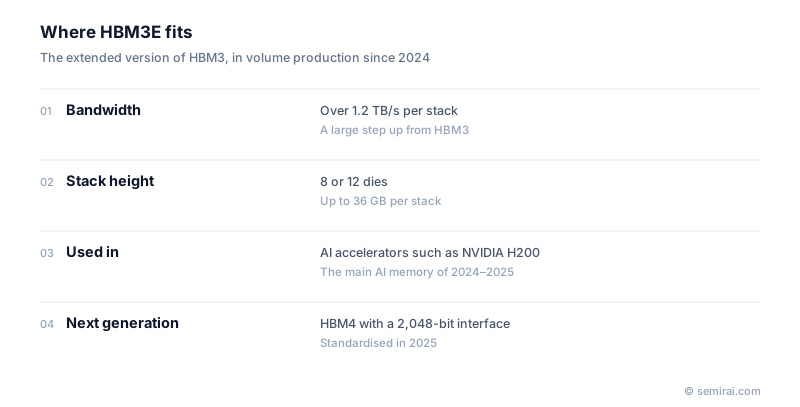
HBM3E is the enhanced version of HBM3 high-bandwidth memory, in volume production since 2024. Each stack of 8 or 12 DRAM dies delivers more than 1.2 TB/s over a 1,024-bit interface, with up to 36 GB per stack, and it is the memory used in most AI accelerators shipped in 2024 and 2025.
Diagram
What it improves
HBM3E keeps the HBM3 interface width but runs it faster, raising the bandwidth of each stack by roughly half. Stacking 12 dies instead of 8 increases capacity to 36 GB per stack, and newer DRAM processes improve energy per bit.
The effect on AI hardware is direct. NVIDIA's H200 uses the same GPU design as the H100 but replaces 80 GB of HBM3 with 141 GB of HBM3E, raising memory bandwidth from 3.35 TB/s to 4.8 TB/s. For large language models, memory capacity and bandwidth often limit performance more than raw compute.
Why yield is the challenge
Every die in a stack has to work, so a 12-high stack multiplies the effect of any defect. Thinning, through-silicon via formation, die-to-die bonding, heat removal between dies and testing each die before stacking all affect cost. Micron and SK hynix started volume production in early 2024, and Samsung also supplies HBM3E.
Supplying HBM3E has reshaped the memory industry. Because the dies are stacked and tested as a set, each supplier must qualify its stacks with each accelerator maker, and the qualification itself can decide market share for a whole product generation.
Japanese companies involved
- DISCO supplies the grinding, polishing and dicing equipment used to thin and cut DRAM wafers for HBM stacks.
- Advantest's memory testers are used to screen DRAM dies and stacks.
FAQ
What is the difference between HBM3 and HBM3E?
HBM3E runs the same 1,024-bit interface at a higher speed and supports taller stacks, so it offers more bandwidth and capacity per stack than HBM3.
What comes after HBM3E?
HBM4, standardised by JEDEC in 2025, doubles the interface to 2,048 bits and moves the base die toward logic processes.
Comparisons
Related pages
Sources
Last updated: November 2, 2026