MRAM (Magnetoresistive Random-Access Memory)
MRAM (magnetoresistive random-access memory) is non-volatile memory that stores each bit in the magnetisation direction of a thin magnetic layer. It keeps data without power like flash, but writes much faster and can be rewritten almost without limit, which makes it attractive as embedded memory in microcontrollers and logic chips.
Also called: STT-MRAM, magnetic RAM
Diagram
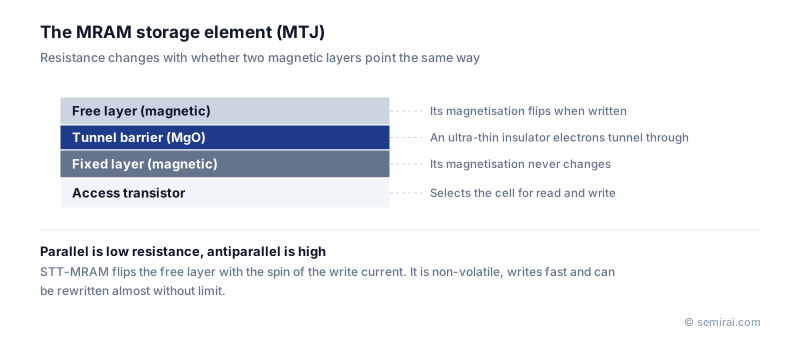
The magnetic tunnel junction
The storage element is a magnetic tunnel junction (MTJ): two ferromagnetic layers separated by an insulating barrier of magnesium oxide only about a nanometre thick. One layer's magnetisation is fixed; the other, the free layer, can point the same way or the opposite way. When the two are parallel, electrons tunnel through the barrier easily and the resistance is low; when they are antiparallel, the resistance is high. The two resistances represent 0 and 1.
In spin-transfer torque MRAM (STT-MRAM), the mainstream type, a write current of spin-polarised electrons flips the free layer. Spin-orbit torque MRAM, still in research, uses a separate write path to switch faster with less wear on the barrier.
Where MRAM is used
MRAM's main market today is embedded memory. Foundries offer eMRAM on 22 nm and 28 nm processes as a replacement for embedded flash, which becomes hard to scale at those nodes. Standalone MRAM chips are used where fast, frequent, power-safe writes matter, such as data logging and industrial control.
Making MRAM means depositing stacks of a dozen or more ultra-thin magnetic and oxide films with tight thickness control, and etching them without damaging the junction.
Japanese companies involved
- ULVAC makes sputtering systems for the multilayer magnetic films of MTJs.
- Tokyo Electron also supplies deposition equipment for MRAM film stacks.
- Tokyo Electron (TEL) · Coat/develop, etch and deposition equipment
- ULVAC · Vacuum deposition (sputtering) equipment and vacuum pumps
FAQ
Is MRAM faster than flash?
Yes. MRAM writes in nanoseconds at low voltage and does not need a block erase, while flash writes take microseconds to milliseconds and need high voltage.
Why is MRAM not used for main memory or SSDs?
Its cells are larger and its cost per bit is much higher than DRAM or NAND, so it is used where speed, endurance and non-volatility matter more than capacity.
Related pages
Sources
Last updated: November 1, 2026