Wedge Bonding
Wedge bonding is a wire bonding method in which the wire is pressed flat onto a pad by a wedge-shaped tool and joined by ultrasonic vibration and force, without first melting a ball on the wire end. It works at room temperature and is the standard way to connect thick aluminium wires in power semiconductors.
Also called: wedge-wedge bonding, ultrasonic wedge bonding, heavy wire bonding
Diagram
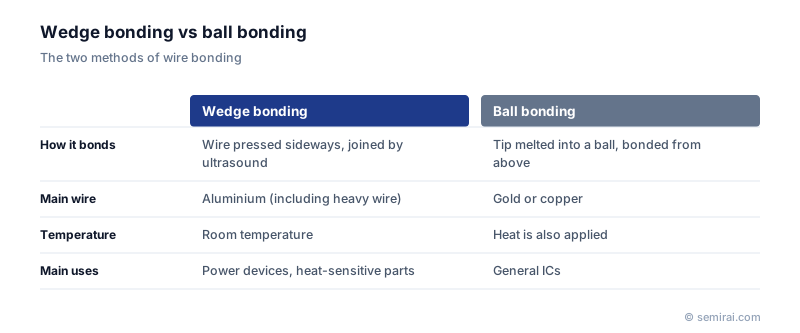
How it differs from ball bonding
In ball bonding, an electric spark melts the wire tip into a ball, which is bonded to the chip with heat, force and ultrasound, and the wire then leaves vertically. Wedge bonding has no ball. The wire is fed under the wedge at an angle, pressed onto the pad and scrubbed ultrasonically until the oxide breaks up and the metals bond. Both ends of the wire are flattened wedge bonds, and the wire leaves the first bond in the direction of the second, so the bonder must rotate the tool or the part to match each wire's direction.
Because the bond is low and the loop can be kept short and flat, wedge bonding is also used where low loop height matters, and because no heat is needed it suits heat-sensitive devices.
Heavy wire and ribbon for power modules
Fine aluminium wire wedge bonding is used for some ICs, but its biggest use is heavy wire bonding. Power modules with IGBTs or SiC MOSFETs connect chips with aluminium wires a few hundred micrometres thick, often many in parallel, or with flat aluminium ribbon. These carry large currents in inverters for electric vehicles, industrial drives and renewable energy.
The wire bonds are often the first part of a power module to fail, as repeated heating and cooling makes them crack or lift. Copper wire, copper-clad aluminium and copper clips are therefore being adopted to carry more current and survive more power cycles, with copper needing higher bonding force and harder tools.
Japanese companies involved
- Japanese power semiconductor makers use heavy aluminium wire wedge bonding in IGBT and SiC power modules, and Japanese wire makers such as Tanaka Precious Metals supply bonding wire.
- Tanaka Precious Metals · Bonding wire and precious metal sputtering targets
- Shinkawa (Yamaha Robotics) · Wire bonders and die bonders
FAQ
What wire is used in wedge bonding?
Mostly aluminium, from fine wire of about 25 µm for ICs to heavy wire of several hundred micrometres for power devices. Aluminium ribbon, copper wire and copper ribbon are also used when more current or better reliability is needed.
Why does wedge bonding not need heat?
The ultrasonic vibration under pressure breaks the oxide film on the wire and pad and brings clean metal into contact, forming a solid-state bond. Ball bonding of gold or copper usually adds heat to help the bond form faster.
Related pages
Sources
Last updated: November 13, 2026