Power Module
A power module is a package that combines several power semiconductor chips, such as IGBTs, power MOSFETs or SiC MOSFETs and their diodes, on an insulating substrate with the wiring and heat path needed to handle high current and voltage. It forms the switching core of inverters for electric vehicles, industrial motors, railways and solar power.
Also called: power semiconductor module, IGBT module, SiC module
Diagram
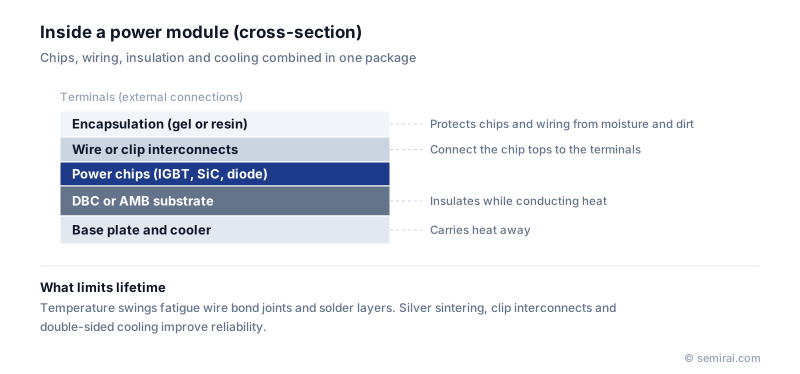
What is inside a power module
The chips are soldered or sintered onto a ceramic substrate with copper on both sides, such as DBC (direct bonded copper) or AMB (active metal brazed) silicon nitride. The ceramic insulates the high-voltage circuit from the heat sink while conducting heat away. Thick aluminium or copper wires, or flat copper clips, connect the top of each chip to the terminals, and the assembly is filled with silicone gel or moulded in resin.
A typical module holds one or more switch-diode pairs arranged as a half bridge or a full three-phase bridge, with several chips in parallel to reach the rated current. Many modules also include a temperature sensor. An intelligent power module (IPM) goes further and adds gate drivers and protection circuits for overcurrent, short circuit and overheating in the same package.
Why packaging decides performance
The chip sets the losses, but the package decides how much of that heat can be removed and how much stray inductance the switching current sees. Fast SiC chips switch so quickly that inductance in the wiring causes voltage overshoot and ringing, so SiC modules use low-inductance layouts, clips instead of long wires, and in some designs cooling from both sides of the chip.
Lifetime is limited by thermal cycling. Each time the load changes, the chip, solder, wires and substrate expand by different amounts, which slowly fatigues wire bonds and solder layers until they lift or crack. Silver sintering, copper wires or clips, and stronger substrates are used to extend power-cycling life, especially for SiC chips that run hotter.
Japanese companies involved
- Mitsubishi Electric and Fuji Electric make IGBT and SiC power modules for industrial drives, railways and vehicles, and Mitsubishi Electric is known for its intelligent power modules.
- ROHM supplies SiC MOSFET chips and SiC power modules.
- Mitsubishi Electric (power devices) · IGBT and SiC power modules, RF and optical devices
- Fuji Electric (power semiconductors) · IGBT modules and SiC power devices
- ROHM · SiC and silicon power devices, analog ICs
FAQ
What is the difference between a power module and a discrete device?
A discrete device is one chip in its own package, such as a TO-247 transistor, mounted on a circuit board. A module places many chips on a shared insulated substrate with a large heat-transfer area, which suits currents from tens to thousands of amperes.
What is power cycling?
Power cycling is a reliability test that heats the chips by passing load current and then lets them cool, over and over. It reproduces the temperature swings of real operation and reveals wear-out of wire bonds and die-attach layers, which usually limits module life.
Why are silicon nitride substrates used?
Silicon nitride is much tougher than alumina, so a thin AMB substrate can survive repeated thermal stress without cracking while still conducting heat reasonably well. Aluminium nitride conducts heat better but is more brittle.
Related pages
Sources
Last updated: November 2, 2026