Wire Sweep
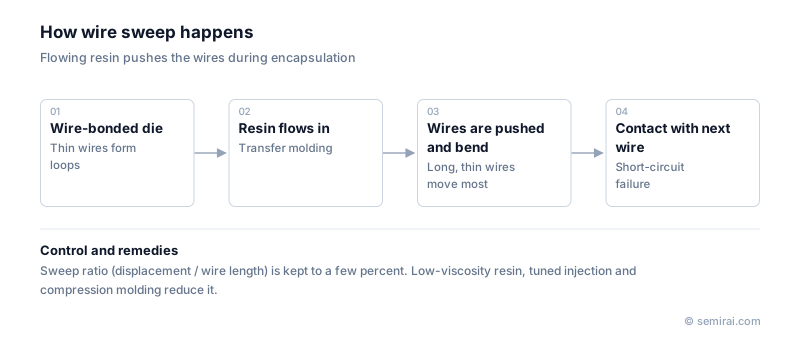
Wire sweep is the bending and displacement of bond wires caused by flowing resin when a wire-bonded chip is encapsulated. If the sweep is large, wires can touch each other and short, touch the die edge, or have their bonds damaged, so it is one of the main defects controlled in molding.
Also called: wire drift, wire wash
Diagram
Why it happens
In transfer molding, molten epoxy molding compound is forced into the mold cavity within seconds. The flowing resin drags on each wire and bends it in the direction of flow. How much depends on the viscosity of the resin, which rises as it begins to cure, on its speed, on the length, diameter, loop height and stiffness of the wire, and on the angle between the flow and the wire.
Long, thin wires sweep most. Copper wire, which is stiffer than gold, tends to resist sweep better. The amount is expressed as the sweep ratio, the maximum sideways displacement divided by the wire length, measured by X-ray imaging. Limits are typically set at a few percent, depending on wire spacing.
How it is controlled
The main remedies are a low-viscosity compound with fine filler, injection speed and pressure that are ramped in stages, and a mold layout in which resin flows from the gate along the wires rather than across them. Package designers also keep wires short and loops low where they can.
Compression molding is the most effective remedy. The compound is placed in the cavity and pressed as the mold closes, so it moves only a short distance sideways and exerts little force on the wires. It is therefore used for stacked memory packages and fine-pitch products with many long, thin wires. Flow simulation is used during design to predict sweep before tooling is made.
Japanese companies involved
- TOWA makes compression molding equipment used to reduce wire sweep, and Sumitomo Bakelite and Resonac supply epoxy molding compounds designed for low-viscosity filling.
- TOWA · Molding (encapsulation) equipment for chip packaging
- Sumitomo Bakelite · Epoxy mold compounds and package materials
- Resonac · CMP slurries, packaging materials and SiC epitaxial wafers
FAQ
Which packages are most prone to wire sweep?
Packages with many long, thin, closely spaced wires, such as stacked memory dies bonded to a substrate or high pin count wire-bonded BGAs. Short wires in small packages are much less affected.
How is wire sweep measured?
Molded packages are imaged with X-rays from above, and the sideways displacement of each wire from its original path is measured and divided by its length. Samples are checked during process development and in regular production monitoring.
Related pages
Sources
Last updated: November 13, 2026