Wire Bonder
A wire bonder is back-end equipment that connects the bond pads of a semiconductor chip to the leads of a lead frame or the pads of a package substrate with fine metal wires. It joins gold, copper or aluminium wire using heat, ultrasonic vibration and force, placing each wire automatically at high speed, and it builds the internal wiring of most chip packages made today.
Also called: wire bonding machine, ball bonder, wedge bonder
Diagram
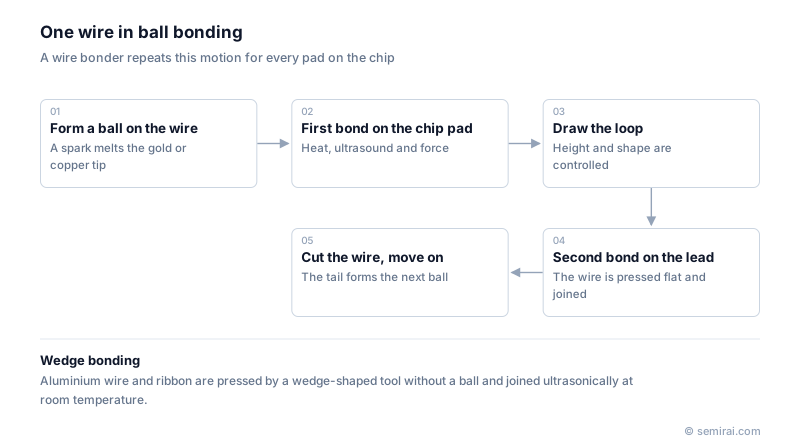
Ball bonders and wedge bonders
Ball bonders handle thin gold and copper wire, typically a few tens of micrometres in diameter. A spark from an electronic flame-off unit melts the wire tip into a ball, which a ceramic capillary presses onto the chip pad with heat and ultrasound (thermosonic bonding). The capillary then draws a loop to the lead, makes a flattened second bond and breaks the wire, leaving a tail for the next ball. Ball bonding is fast and direction-free, so it is used for most ICs.
Wedge bonders press the wire flat with a wedge-shaped tool and join it by ultrasonic energy, usually at room temperature, without forming a ball. They are used mainly for aluminium wire. Heavy aluminium wire up to about half a millimetre thick, and flat aluminium or copper ribbon, carry the large currents of IGBT and SiC power modules, while fine aluminium wedge bonding is used in some sensors and RF parts.
What the machine has to control
A modern bonder combines a high-speed XY table, a bond head with an ultrasonic transducer, cameras that locate every pad, and loop control that shapes each wire. Bond parameters such as force, ultrasonic power, time and temperature must suit the wire, the pad metallurgy and the package, because weak bonds, cratered pads or sagging loops cause failures later.
The move from gold to copper wire to save cost made the job harder: copper is harder and oxidises, so bonders use a forming gas shroud and finer force control, and palladium-coated copper wire is common.
Wire bonding versus other interconnects
Flip-chip bumps, hybrid bonding and through-silicon vias give shorter paths and more connections for processors and HBM. Wire bonding remains the lowest-cost, most flexible choice for microcontrollers, analog and power devices, memory cards and stacked NAND packages.
Japanese companies involved
- Shinkawa (Yamaha Robotics) and Kaijo make wire bonders used in IC assembly.
- Tanaka Precious Metals makes gold, copper and other bonding wire used on these machines.
- Tanaka Precious Metals · Bonding wire and precious metal sputtering targets
- Shinkawa (Yamaha Robotics) · Wire bonders and die bonders
- Kaijo · Wire bonders and ultrasonic cleaning systems
FAQ
Which companies make wire bonders?
Kulicke & Soffa of the United States and ASM Pacific Technology are large suppliers of ball bonders, and Kulicke & Soffa also makes heavy-wire wedge bonders through its former Orthodyne business. Japanese suppliers include Shinkawa and Kaijo. Outsourced assembly companies such as ASE operate wire bonders but do not make them.
Why is copper wire replacing gold?
Copper costs far less than gold and conducts electricity and heat better, which matters when a package holds hundreds of wires. Gold is still chosen where reliability or process margin matter most.
What is the difference between a wire bonder and a die bonder?
A die bonder picks the chip from the diced wafer and attaches it to the lead frame or substrate with adhesive, solder or sintered silver. The wire bonder comes next and makes the electrical connections between the attached chip and the package.
Related pages
Sources
Last updated: November 2, 2026