Bonding Wire
Bonding wire is the fine metal wire used in wire bonding to connect the pads on a chip to the terminals of a leadframe or package substrate. It is thinner than a human hair, typically about 15-50 µm in diameter, while power devices use aluminium wire a few hundred micrometres thick to carry large currents.
Also called: bond wire, gold wire, copper wire
Diagram
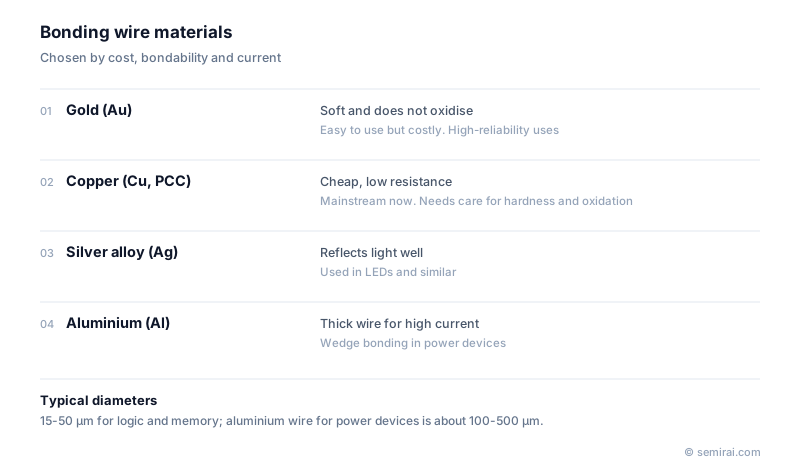
Wire materials
Four materials dominate. Gold is soft and does not oxidise, so it is easy to bond and was the standard for decades, but it is expensive. Copper is now the most widely used material, often coated with palladium (palladium-coated copper, PCC). Copper is cheaper and conducts better, but it is harder and can damage the chip pad, and it oxidises, so the ball must be formed under a nitrogen-hydrogen gas mixture.
Silver-alloy wire is used in LEDs and some other devices, and aluminium wire is used mainly for wedge bonding in power semiconductors.
Quality and reliability
Wire is judged by diameter uniformity, elongation and tensile strength, and how consistently it forms a free-air ball. Bond strength is checked with wire pull tests and ball shear tests.
During moulding, flowing resin can push wires sideways until neighbours touch, a defect called wire sweep. Wire length and loop shape are therefore designed together with the mould flow. Over long periods at high temperature, intermetallic growth at the bond, and the voids that can accompany it, also limit reliability, which is one reason the wire and pad metals are chosen as a pair.
Japanese companies involved
- Tanaka Precious Metals and Nippon Micrometal manufacture gold, copper and other bonding wires used by assembly plants worldwide.
- Tanaka Precious Metals · Bonding wire and precious metal sputtering targets
- Nippon Micrometal · Bonding wire and micro balls
FAQ
Why did the industry move from gold to copper wire?
Mainly because of the large rise in the gold price. Copper costs far less and has lower electrical resistance. Its drawbacks, hardness and oxidation, were addressed with palladium coating, forming-gas ball formation and bonder process changes.
Why do power devices use thick aluminium wire?
They carry large currents, so wires of roughly 100-500 µm diameter are needed. Aluminium is light, inexpensive and matches the aluminium pads on the chip, and it is joined by ultrasonic wedge bonding. Copper wire, ribbon and clip bonding are increasingly replacing it.
Related pages
Sources
Last updated: November 13, 2026