IGBT (Insulated Gate Bipolar Transistor)
An IGBT (insulated gate bipolar transistor) is a power semiconductor switch that combines the voltage-driven gate of a MOSFET with the low conduction loss of a bipolar transistor. It can switch hundreds of volts to several kilovolts and currents up to the kiloampere range efficiently, which makes it a standard switch in power conversion.
Also called: insulated-gate bipolar transistor
Diagram
How an IGBT works
Structurally, an IGBT resembles a vertical power MOSFET with an extra p-type layer added on the collector side. A positive voltage on the insulated gate forms a channel, just as in a MOSFET, so the gate draws almost no steady current and is easy to drive. Once the channel is on, holes are injected from the p-type collector into the thick, lightly doped drift layer.
These injected holes, together with the electrons, flood the drift layer and sharply lower its resistance. This effect, called conductivity modulation, gives the IGBT a low on-state voltage even at high voltage ratings, where a silicon MOSFET's drift resistance would be large. The cost comes at turn-off: the stored carriers must recombine before the current stops, producing a tail current that adds switching loss and limits the practical switching frequency.
Where IGBTs are used
The main job of the IGBT is the inverter, the circuit that turns DC into variable-frequency AC to drive a motor. IGBTs are used in hybrid and electric vehicle drive inverters, industrial motor drives and robots, inverter air conditioners and refrigerators, power conditioners for solar and wind generation, and traction inverters for high-speed trains and metros. High-power units are usually built as modules that combine several IGBT chips with freewheeling diodes on an insulated substrate.
Silicon IGBTs rely on a mature, low-cost process that includes diffusion, ion implantation and back-side wafer thinning. In applications where high frequency, high temperature or maximum efficiency matter, silicon carbide (SiC) MOSFETs are replacing them, while IGBTs remain strong where cost and very high current dominate.
Japanese companies involved
- Mitsubishi Electric and Fuji Electric make IGBT chips and IGBT modules for industrial drives, railways, renewable energy and vehicles.
- Toshiba Electronic Devices & Storage makes discrete IGBTs and IGBT-based products for consumer and industrial inverters.
- Mitsubishi Electric (power devices) · IGBT and SiC power modules, RF and optical devices
- Fuji Electric (power semiconductors) · IGBT modules and SiC power devices
- Toshiba Electronic Devices & Storage · Power MOSFETs, IGBTs and discrete semiconductors
FAQ
What is the difference between an IGBT and a power MOSFET?
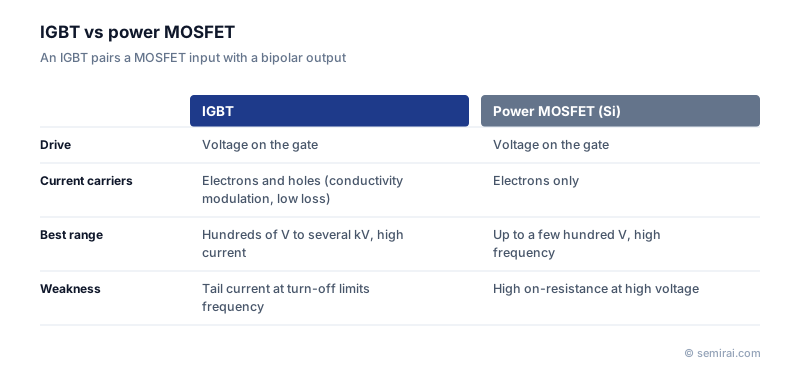
Both are driven by a gate voltage. A MOSFET conducts with electrons only, so it switches fast but its on-resistance rises steeply at high voltage ratings. An IGBT conducts with both electrons and holes, giving low conduction loss at high voltage, but its turn-off tail current makes it slower.
Why does an IGBT need a separate diode?
An IGBT cannot conduct current in the reverse direction, but inverter circuits need a path for inductive load current when the switch turns off. A freewheeling diode is therefore connected in antiparallel, usually inside the same module. Reverse-conducting IGBTs integrate both functions on one chip.
Will SiC replace the IGBT completely?
Not in the near term. SiC MOSFETs win where switching frequency, temperature and efficiency justify their higher cost, such as many EV inverters. Silicon IGBTs remain competitive in cost-sensitive and very high-current applications, so the two technologies are expected to coexist.
Comparisons
Related pages
Sources
Last updated: November 2, 2026