SiC MOSFET (Silicon Carbide MOSFET)
A SiC MOSFET is a power MOSFET made from silicon carbide (SiC) instead of silicon. SiC has about three times the bandgap of silicon, roughly ten times its breakdown field and about three times its thermal conductivity, so SiC MOSFETs can block high voltages, run hot and switch fast with low loss.
Also called: silicon carbide MOSFET, SiC power MOSFET
Diagram
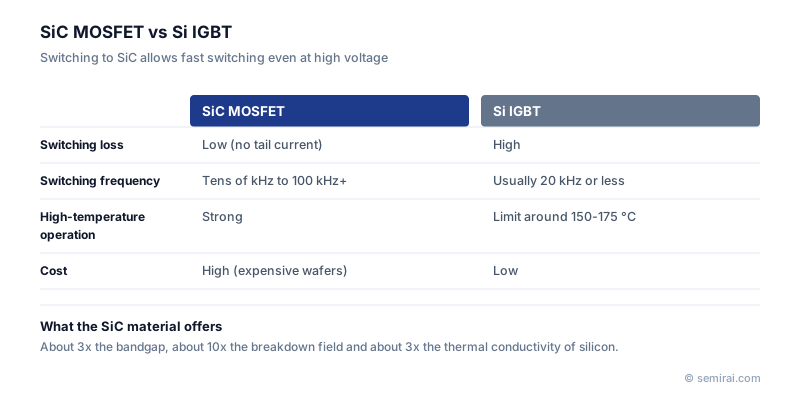
Why silicon carbide helps
The bandgap of 4H-SiC, the polytype used for power devices, is about 3.26 eV against 1.12 eV for silicon. Its much higher critical electric field means the drift layer that holds off the voltage can be about one tenth as thick and far more heavily doped for the same rating. That cuts the drift resistance dramatically, so a SiC MOSFET reaches 1200 V and above with an on-resistance that a silicon MOSFET cannot match.
Because the MOSFET conducts with majority carriers only, it has no tail current at turn-off. Switching loss is therefore much lower than in a silicon IGBT of the same voltage class, and the switching frequency can be raised. Higher frequency shrinks inductors, capacitors and filters, and lower loss reduces the cooling needed.
Where SiC MOSFETs are used
Electric vehicles are the largest application: traction inverters, on-board chargers (OBC) and DC-DC converters, especially in 800 V battery systems. Other uses include solar inverters, fast EV chargers, industrial power supplies and railway traction. Lower inverter losses translate into longer driving range or a smaller battery for the same range.
How SiC MOSFETs are made
SiC needs dedicated processes. Wafers are mainly 150 mm, with a transition to 200 mm under way. The drift layer is grown by high-temperature chemical vapour deposition (CVD) epitaxy. Dopants barely diffuse in SiC, so doping is done by ion implantation at elevated temperature followed by activation annealing well above 1500 °C. The quality of the gate oxide and the SiO2/SiC interface strongly affects channel mobility and threshold-voltage stability, and is one of the key engineering challenges.
Japanese companies involved
- ROHM makes SiC MOSFETs and SiC Schottky diodes, and through its subsidiary SiCrystal also produces SiC substrates.
- Toshiba Electronic Devices & Storage and Mitsubishi Electric supply SiC MOSFETs and SiC power modules for industrial, railway and automotive use.
- Denso develops SiC power devices for the inverters of electrified vehicles.
- ROHM · SiC and silicon power devices, analog ICs
- Mitsubishi Electric (power devices) · IGBT and SiC power modules, RF and optical devices
- Denso · Automotive power semiconductors, sensors and ICs
- Toshiba Electronic Devices & Storage · Power MOSFETs, IGBTs and discrete semiconductors
FAQ
Why are SiC MOSFETs more expensive than silicon devices?
SiC crystals grow slowly and are hard to slice and polish, so substrates cost far more than silicon wafers and defect densities are higher. High-temperature implantation, annealing and epitaxy add further cost. Prices fall as 200 mm wafers and higher yields arrive, but the gap with silicon remains.
What is the gate oxide problem in SiC MOSFETs?
The interface between SiC and its thermal oxide contains more traps than the silicon-oxide interface. These traps lower channel mobility and can shift the threshold voltage over time. Manufacturers use special oxidation and nitridation processes and careful qualification to keep the threshold stable.
How does a SiC MOSFET compare with a GaN transistor?
Both are wide-bandgap devices. SiC MOSFETs are vertical devices suited to high voltages and high power, typically 650 V to 1700 V and above. GaN HEMTs are lateral devices that switch even faster and dominate compact chargers and power supplies at roughly 650 V and below.
Comparisons
Related pages
- Silicon Carbide (SiC)
- Gallium Nitride (GaN)
- IGBT (Insulated Gate Bipolar Transistor)
- Power Semiconductor
- MOSFET (Metal-Oxide-Semiconductor Field-Effect Transistor)
- Compound Semiconductor
- Silver Sintering
- Wide Bandgap Semiconductor (WBG)
- Power semiconductor manufacturing equipment
- Advantest EXAVIS
- Advantest MT100 / MT200
- Hitachi High-Tech M-600 / 6000 series
Sources
Last updated: November 2, 2026