CCD (Charge-Coupled Device)
A CCD (charge-coupled device) is an image sensor that converts light to charge in photodiodes and reads it out by shifting the charge step by step across the chip, like a bucket brigade, to a single output amplifier. Invented in 1969, CCDs dominated digital and video cameras and scientific imaging for decades thanks to their low noise and uniformity, before CMOS sensors replaced them.
Also called: CCD image sensor
Diagram
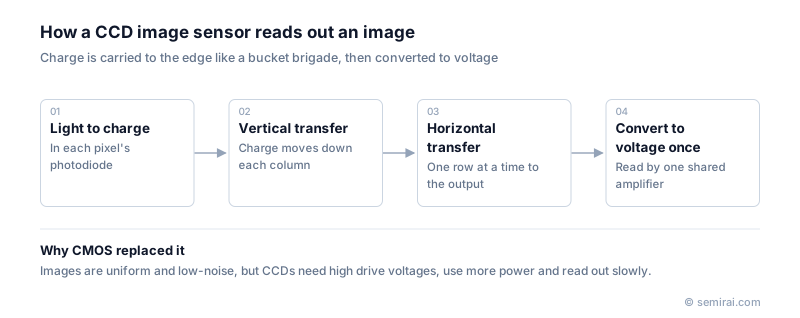
How a CCD reads out an image
Each pixel collects the charge generated by incoming light during the exposure. Clock voltages applied to closely spaced electrodes then move the charge packets down vertical shift registers, one row at a time, into a horizontal register. The horizontal register moves each packet to the output, where a single amplifier converts it to a voltage.
Because every pixel passes through the same amplifier, and charge transfer is extremely efficient, CCDs give very uniform, low-noise images. The drawbacks are the multiple, relatively high clock voltages they need, higher power consumption, slow serial readout, and the difficulty of integrating timing, conversion and processing circuits on the same chip.
Why CMOS sensors took over
CMOS sensors amplify charge inside each pixel and read rows in parallel, so they are faster and use less power, and they can include ADCs and image processing on chip at lower cost. As CMOS noise performance improved with process technology and pinned photodiodes, the image quality advantage of CCDs faded, and the growth of smartphone cameras completed the shift.
The CCD was invented by Willard Boyle and George Smith at Bell Labs, who shared the 2009 Nobel Prize in Physics for it.
Japanese companies involved
- Sony was a leading CCD maker for consumer and professional cameras before moving its business to CMOS image sensors.
- Hamamatsu Photonics makes CCD and other image sensors for scientific, spectroscopic and industrial instruments.
- Sony Semiconductor Solutions · CMOS image sensors
- Hamamatsu Photonics · Failure analysis, process monitoring and static elimination equipment
- Canon · Lithography steppers and nanoimprint lithography
FAQ
Are CCDs still used?
Yes, in niches such as astronomy, spectroscopy and some scientific and industrial inspection where very low noise and high uniformity matter. They have almost disappeared from consumer products, and major makers have reduced production.
What is charge transfer efficiency?
It is the fraction of a charge packet that survives each transfer step. Because a packet may be shifted thousands of times before readout, efficiencies extremely close to 100% are needed, and CCDs achieve this, which is the root of their low noise and uniformity.
Related pages
Sources
Last updated: November 2, 2026