GAA (Gate-All-Around)
GAA (gate-all-around) is a three-dimensional transistor structure in which the gate electrode surrounds the channel on every side. A FinFET gate covers a vertical fin on three sides; in a GAA transistor the channel is a thin silicon nanosheet or nanowire that the gate wraps completely. The stronger control lets transistors keep shrinking without excessive leakage.
Also called: gate-all-around FET, GAAFET
Diagram
Why the gate needs to wrap the channel
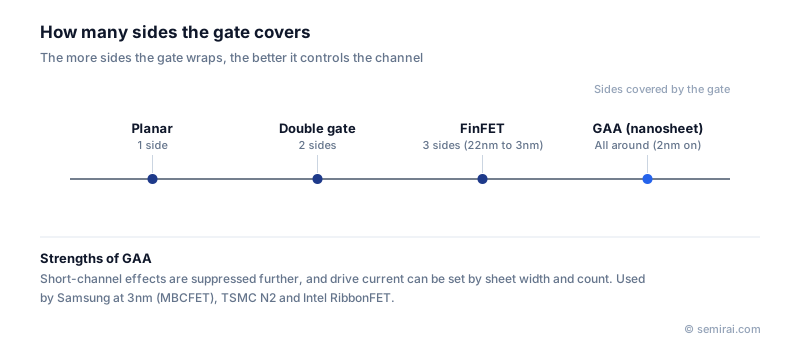
As gate length shrinks, the drain voltage starts to influence the channel as much as the gate does. The transistor no longer switches off cleanly and leaks current, a family of problems called short-channel effects. Surrounding the channel with more gate surface restores control: the planar transistor covered one side, double-gate designs two, FinFETs three, and GAA all four.
GAA also adds design freedom. In a FinFET the drive current can only be changed in steps by adding fins. In a nanosheet GAA transistor the sheet width can be drawn wider or narrower, so designers can tune each transistor for speed or for low power.
Who uses GAA
Samsung was first, starting production of a 3nm process with its MBCFET (multi-bridge channel FET) in 2022. TSMC moved to nanosheets with its N2 process, which entered volume production in the fourth quarter of 2025, and Intel uses its own version, called RibbonFET, in Intel 18A. The implementations differ in sheet width, number of stacked sheets and process details.
Japanese companies involved
- Rapidus is developing a 2nm GAA process at its pilot line in Chitose, Hokkaido.
- Tokyo Electron supplies etch and deposition equipment used for the selective etching and gate-stack steps that GAA requires.
- Rapidus · Leading-edge logic foundry (2 nm, in development)
FAQ
Is a nanosheet transistor the same as GAA?
A nanosheet transistor is the main form of GAA in production. GAA is the general idea of a gate surrounding the channel; the channel can be a narrow wire (nanowire) or a wider flat sheet (nanosheet). Sheets carry more current per footprint, so the industry chose them.
What comes after GAA nanosheets?
Researchers are working on forksheet transistors, which place n-type and p-type sheets on either side of a thin dielectric wall, and CFET (complementary FET), which stacks the n-type and p-type devices on top of each other to save area.
Comparisons
Related pages
Sources
Last updated: November 2, 2026