Differential Amplifier
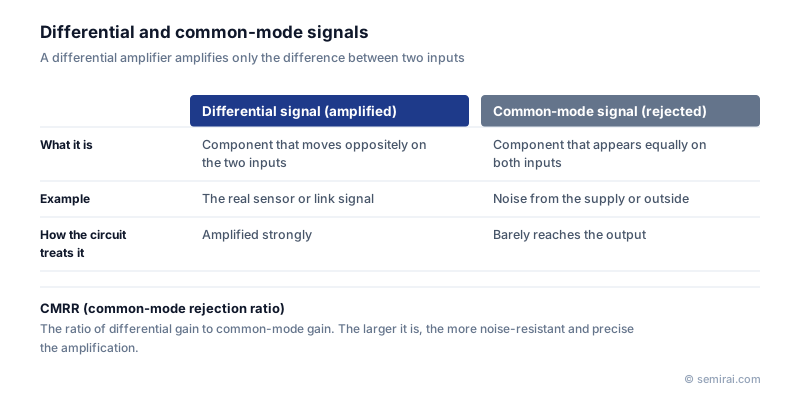
A differential amplifier amplifies the difference between two input signals while cancelling noise that appears equally on both (the common-mode signal). Its ability to reject that common noise, measured as the common-mode rejection ratio (CMRR), makes it the basic building block of precise, noise-resistant analog amplification, used in op-amps and almost every analog integrated circuit.
Also called: differential pair, long-tailed pair
Diagram
How the circuit works
The basic circuit is a matched pair of transistors whose sources (or emitters) are tied together and fed by a constant current source, often called the tail current. If both inputs rise together, the shared current does not change and the output stays almost still. If one input rises and the other falls, current shifts from one side of the pair to the other and the output changes strongly.
Using a current mirror as the load converts the differential signal into a single-ended output efficiently. The more symmetrical the two halves, the better the circuit cancels temperature drift and supply variations, so layout matching is an important part of analog design.
Where differential circuits are used
Differential pairs form the input stage of op-amps and comparators, the front end of ADCs, and the transmitters and receivers of high-speed serial links. Sending a signal as a differential pair over two wires also makes it robust to noise picked up along the way, because the noise lands on both wires and cancels at the receiver. Interfaces such as LVDS, PCIe and USB rely on this principle.
Japanese companies involved
- Renesas Electronics, ROHM and Toshiba Electronic Devices & Storage make op-amps and other analog ICs built around differential input stages.
- Nisshinbo Micro Devices also supplies op-amps, comparators and other analog ICs.
- Renesas Electronics · Microcontrollers, automotive SoCs, analog and power chips
- ROHM · SiC and silicon power devices, analog ICs
- Toshiba Electronic Devices & Storage · Power MOSFETs, IGBTs and discrete semiconductors
FAQ
Why is a differential circuit resistant to noise?
Noise coupled from outside usually appears almost equally on both inputs. Because the circuit amplifies only the difference, that common noise largely cancels, while the wanted signal, carried as a difference, is amplified. CMRR expresses how strongly the common part is suppressed.
What is offset voltage?
Ideally, zero input difference gives zero output. Small mismatches between the two transistors from manufacturing produce a small output anyway; the input-referred value of that error is the offset voltage. Precision circuits reduce it with careful layout, trimming, or chopper and auto-zero techniques.
Related pages
Sources
Last updated: November 2, 2026