FinFET
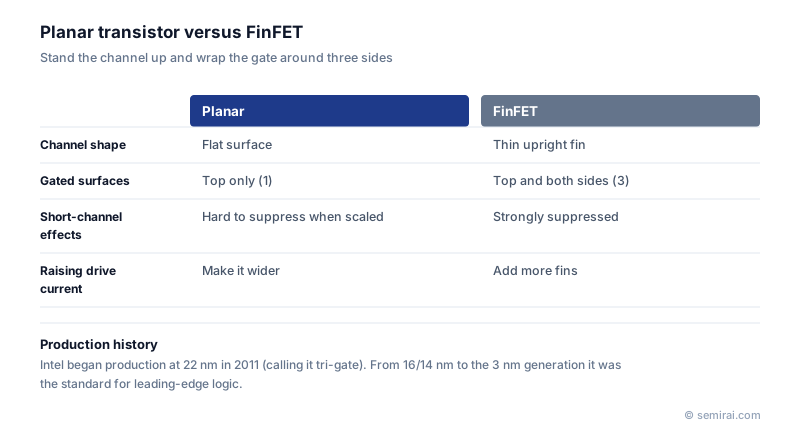
A FinFET is a three-dimensional transistor in which the channel is a thin vertical fin of silicon and the gate wraps around it on three sides: the top and both side walls. Intel was first to mass-produce it, at 22 nm in 2011-2012, and it replaced the planar MOSFET as the standard structure for leading-edge logic down to the 3 nm generation.
Also called: fin field-effect transistor, tri-gate transistor, 3D transistor
Diagram
Why the fin was needed
In a planar transistor the gate sits only on top of the channel. As gate length shrank below about 30 nm, the drain's electric field reached under the gate and allowed current to leak between source and drain even when the transistor was off. These short-channel effects raised standby power and made the threshold voltage hard to control.
Standing the channel up as a thin fin and wrapping the gate around three sides gives the gate much stronger electrostatic control. If the fin is thin enough, no part of the channel is far from the gate, so leakage falls and the transistor switches more sharply. This allowed lower supply voltages and better performance per watt.
How FinFETs are built
Fins are etched into the silicon wafer and isolated at their base by oxide. Because fin pitch is smaller than a single lithography exposure could print at the time, fins are usually made with spacer-based multiple patterning such as self-aligned double or quadruple patterning, then cut to length. Fin width, height and sidewall profile must be very uniform, so etch control is critical.
The gate is formed in a gate-last (replacement metal gate) flow with high-k dielectric and metal gate layers deposited conformally over the fin, and source and drain regions are grown epitaxially, often with silicon germanium for p-type transistors. Drive current is set by the number of fins per transistor, so width comes in discrete steps, which designers have to take into account.
From FinFET to gate-all-around
TSMC, Samsung and GlobalFoundries moved to FinFETs at the 16/14 nm generation, and TSMC kept them through its 3 nm (N3) node. At around 3 nm and 2 nm, fins cannot be made much thinner or taller, so the industry is moving to gate-all-around (GAA) nanosheet transistors, where the gate surrounds stacked horizontal channels on all sides. Samsung introduced GAA at 3 nm, and TSMC's N2 and Intel's 18A use it.
Japanese companies involved
- Rapidus is developing 2 nm logic based on gate-all-around transistors, the successor structure to the FinFET.
- Tokyo Electron supplies etch, deposition and coat/develop equipment used to pattern and build fins and gate stacks.
- Rapidus · Leading-edge logic foundry (2 nm, in development)
- Tokyo Electron (TEL) · Coat/develop, etch and deposition equipment
FAQ
Is a FinFET the same as Intel's tri-gate transistor?
Yes. Intel called its first FinFET a tri-gate transistor, emphasising the three gated surfaces of the fin. The concept goes back to research in the late 1990s, including the FinFET work at the University of California, Berkeley.
Why do FinFET designs use a whole number of fins?
Each fin adds a fixed amount of channel width, so a transistor's width can only grow in steps of one fin. Standard cells are therefore described by fin count, and reducing the number of fins per transistor has been one way to shrink cell height.
Are FinFETs still being used?
Yes. Most chips made at the 16 nm to 3 nm generations use FinFETs, and these nodes will stay in production for many years. Gate-all-around transistors are replacing them only at the newest nodes.
Comparisons
Related pages
Sources
Last updated: November 2, 2026