Photodiode
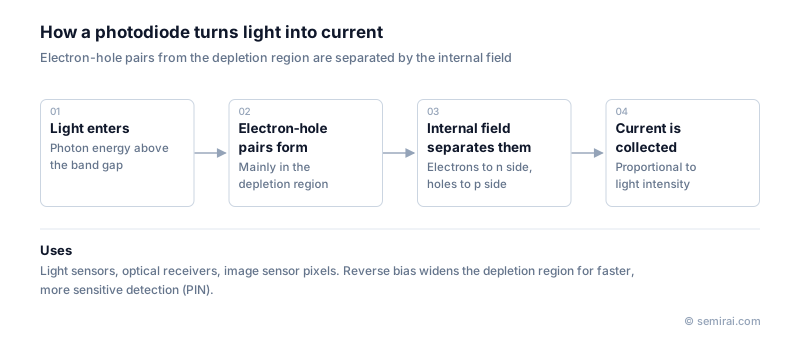
A photodiode is a light-receiving device that converts light into an electrical signal. When light strikes its pn junction or PIN structure, it generates electron-hole pairs that the internal electric field separates into a current. The current is proportional to light intensity, so photodiodes are used in optical sensors, optical communication receivers and image sensor pixels.
Also called: PIN photodiode, avalanche photodiode, APD
Diagram
How it works
A photon with energy greater than the semiconductor's band gap can lift an electron into the conduction band, leaving a hole behind. If this happens in or near the depletion region of the junction, the built-in field pushes the electron toward the n side and the hole toward the p side, and the result is a photocurrent in the external circuit.
Applying a reverse bias widens the depletion region, which collects more carriers and reduces capacitance. A PIN photodiode inserts a lightly doped intrinsic layer between p and n regions for the same purpose, giving fast response and good sensitivity. The material sets the wavelength range: silicon covers visible and near-infrared light, while germanium and InGaAs extend further into the infrared for fibre communication.
Where photodiodes are used
Single photodiodes are used in light sensors, remote control receivers, optical disc readers and receivers in optical fibre links. Arranged in a two-dimensional array, with circuits to read out each pixel, they form CMOS image sensors and CCDs, the imaging devices in cameras, smartphones and vehicles.
An avalanche photodiode (APD) operates at high reverse voltage so that carriers multiply by impact ionisation, giving internal gain. APDs and their single-photon variants are used in LiDAR, long-distance optical communication and low-light measurement. Solar cells work on the same principle but are designed to deliver power rather than a signal.
Japanese companies involved
- Sony Semiconductor Solutions makes CMOS image sensors, which are built from large arrays of photodiode pixels.
- Hamamatsu Photonics makes photodiodes, avalanche photodiodes and other light sensors, and ROHM makes photodiodes and optical sensors for consumer and industrial equipment.
- Sony Semiconductor Solutions · CMOS image sensors
- Hamamatsu Photonics · Failure analysis, process monitoring and static elimination equipment
- ROHM · SiC and silicon power devices, analog ICs
FAQ
What is the difference between a photodiode and a phototransistor?
A phototransistor uses the light-generated current as the base current of a bipolar transistor, so it amplifies the signal internally. It is more sensitive but slower and less linear than a photodiode.
What is dark current?
Dark current is the small current a photodiode passes with no light, caused by thermally generated carriers and leakage. It sets the lower limit of detectable light and roughly doubles with every several degrees of temperature rise.
Related pages
Sources
Last updated: November 2, 2026