FeRAM (Ferroelectric RAM)
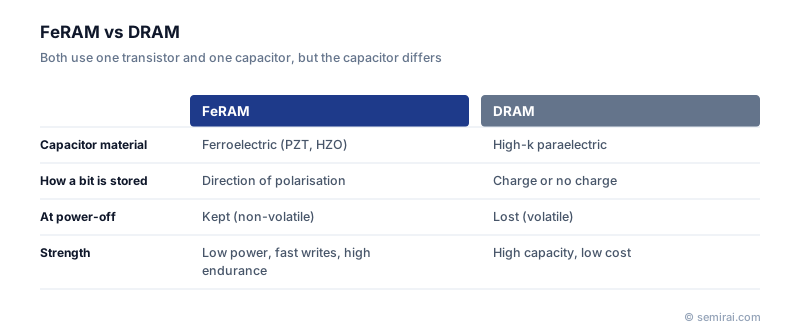
FeRAM (ferroelectric random-access memory, also written FRAM) is non-volatile memory that stores each bit as the direction of electric polarisation in a ferroelectric capacitor. The cell looks like a DRAM cell, but the polarisation stays after power is removed, so data is kept without refresh or power.
Also called: FRAM, ferroelectric memory
Diagram
How it works
A ferroelectric material has a built-in electric polarisation that an applied field can flip between two directions, and that stays put when the field is removed. FeRAM uses this as its memory: a one-transistor, one-capacitor cell with a ferroelectric film such as lead zirconate titanate (PZT) in the capacitor. Reading applies a field and senses whether the polarisation flips, so like DRAM the value has to be written back after a read.
Writing needs only a low voltage and takes nanoseconds, with no charge pump or long erase as in flash. Cells can be rewritten trillions of times.
Uses and new materials
These properties make FeRAM a good fit for frequent, small writes with little power: smart cards, meters, data loggers, industrial controllers and medical devices. Its weakness is density, because PZT is hard to scale and integrate with advanced CMOS.
Ferroelectric hafnium oxide, reported in 2011, has revived interest. It is already used as a high-k gate dielectric in CMOS, so it can be scaled far further than PZT, and it is being studied for ferroelectric transistors (FeFET) and dense embedded memories.
Japanese companies involved
- Japanese companies have long been among the main FeRAM suppliers; ROHM's group company LAPIS Technology has offered FeRAM products.
- ROHM · SiC and silicon power devices, analog ICs
FAQ
How is FeRAM different from DRAM?
Both use a one-transistor, one-capacitor cell, but FeRAM's capacitor holds a ferroelectric film whose polarisation remains without power. DRAM stores charge that leaks and must be refreshed, and loses data at power-off.
Why is FeRAM not used for large memories?
Conventional ferroelectric materials are difficult to shrink and integrate, so FeRAM chips have much lower capacity than DRAM or flash. Hafnium-oxide ferroelectrics may change this.
Related pages
Sources
Last updated: November 1, 2026