DUV Lithography Equipment
DUV lithography equipment is reduction projection exposure equipment that uses deep ultraviolet light, almost always from a KrF (248 nm) or ArF (193 nm) excimer laser, to print circuit patterns onto photoresist. It is the most widely installed class of lithography tool, and ArF immersion versions combined with multi-patterning carried volume production down to the 7 nm generation.
Also called: DUV scanner, deep ultraviolet lithography system, KrF scanner, ArF scanner
Diagram
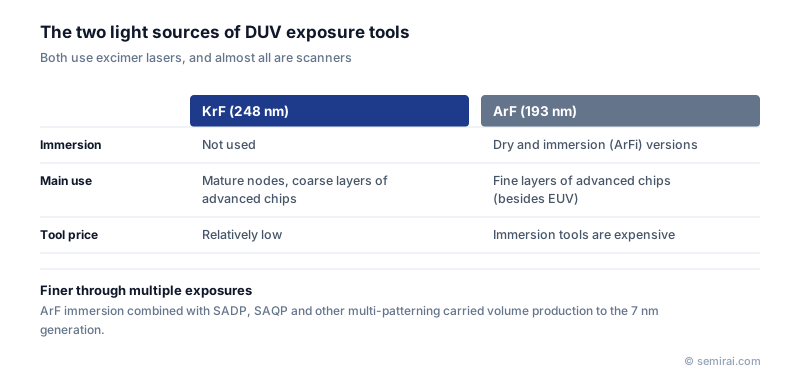
KrF, ArF dry and ArF immersion
KrF scanners at 248 nm print the less demanding layers of logic and memory chips and many layers of mature-node, analogue and power devices. ArF tools at 193 nm come in two forms. Dry ArF scanners have air between the lens and the wafer, which limits the numerical aperture (NA) to below 1. ArF immersion (ArFi) scanners fill that gap with ultrapure water, whose refractive index of about 1.44 at 193 nm allows an NA of up to 1.35 and correspondingly finer patterns.
Nearly all DUV tools for front-end production are step-and-scan systems that expose each field through a slit while the reticle and wafer move in sync, using refractive lenses and a 4x reduction.
Why DUV is still needed alongside EUV
Even on leading-edge chips, only the most critical layers are printed with EUV. The rest, often the majority of patterned layers, are printed on ArFi, ArF dry or KrF tools, which cost much less per exposure. For the tightest DUV layers, chipmakers use self-aligned double or quadruple patterning (SADP, SAQP) or repeated litho-etch steps to reach pitches below what a single ArFi exposure can resolve.
Mature-node fabs making microcontrollers, sensors, power and analogue chips run almost entirely on DUV and older i-line tools, so demand for DUV systems continues well after EUV entered production.
Japanese companies involved
- Nikon builds ArF immersion, ArF dry and KrF scanners (its NSR-S series) as well as i-line steppers.
- Canon builds KrF scanners and i-line steppers for front-end and packaging lithography.
- Gigaphoton makes KrF and ArF excimer lasers that serve as the light source in DUV scanners.
- Gigaphoton · Excimer laser light sources for lithography
- Nikon · ArF, KrF and i-line lithography systems
- Canon · Lithography steppers and nanoimprint lithography
FAQ
Is ArF immersion the same as DUV?
ArF immersion is one kind of DUV lithography. DUV covers both 248 nm KrF and 193 nm ArF tools; ArF tools can be dry or immersion. Immersion only refers to the water layer between the final lens and the wafer.
What limits how small DUV can print?
With a 193 nm wavelength and an NA of 1.35, a single ArFi exposure reaches a half-pitch of roughly 38-40 nm. Smaller pitches need multi-patterning, which adds deposition, etch and lithography steps and makes overlay control harder.
Who supplies DUV lithography tools?
ASML, Nikon and Canon. ASML and Nikon make ArF immersion scanners; Canon focuses on KrF and i-line tools. The excimer laser light sources come from Cymer, an ASML company, and Gigaphoton.
Related pages
Sources
Last updated: November 13, 2026