Immersion Lithography (ArFi)
Immersion lithography is a lithography technique that fills the gap between the final projection lens and the wafer with ultrapure water instead of air. Water's refractive index of about 1.44 at 193 nm shortens the effective wavelength to about 134 nm and lets the numerical aperture (NA) exceed 1, up to 1.35, compared with about 0.93 for dry ArF.
Also called: ArF immersion, 193 nm immersion lithography, ArFi
Diagram
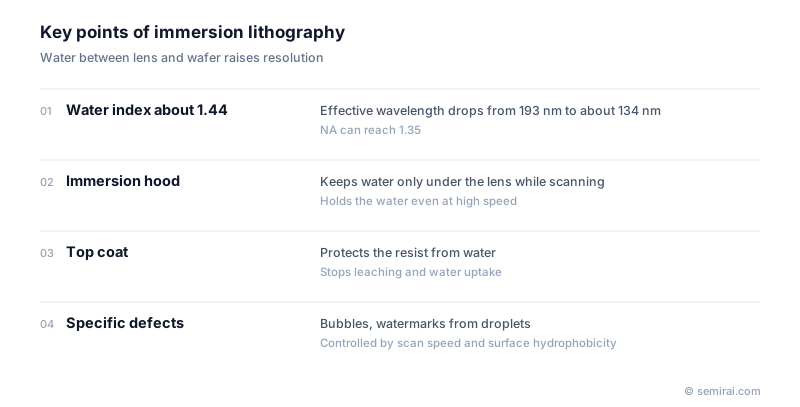
How the water layer works
In air, light leaving the lens at steep angles is lost, so NA cannot exceed 1. With water in the gap, those steep rays can reach the resist, and NA = n × sinθ rises in proportion to the refractive index. Higher NA directly improves resolution in the Rayleigh relation, and the same principle also gives more depth of focus at a given resolution.
The water is held only under the lens by an immersion hood that supplies and recovers it while the wafer stage scans at high speed. The water must stay bubble-free, temperature-controlled and clean, and must not be left behind on the wafer.
Defects and the resist stack
Immersion introduced its own defect types: bubbles that distort the image, watermarks left by stray droplets, resist components leaching into the water, and particles carried by the water. Chipmakers addressed these with water-repellent top coats or top-coat-free resists, careful hood design and scan-speed limits.
ArF immersion entered volume production in the second half of the 2000s and became the main tool for the finest layers until EUV arrived. Combined with multi-patterning such as litho-etch-litho-etch (LELE) and self-aligned double and quadruple patterning (SADP, SAQP), it carried production to the 10 nm and 7 nm generations, and it still prints many layers of leading-edge chips today.
Japanese companies involved
- Nikon builds ArF immersion scanners (its NSR-S series) for front-end production.
- Tokyo Electron makes the coater/developer tracks that apply and develop immersion resists and top coats in line with the scanner.
- Nikon · ArF, KrF and i-line lithography systems
- Tokyo Electron (TEL) · Coat/develop, etch and deposition equipment
FAQ
Why does immersion improve resolution?
Resolution follows R = k₁ × λ / NA. Water both shortens the effective wavelength in the medium and allows NA above 1, so the minimum printable pitch shrinks. For ArF immersion the single-exposure limit is roughly 38-40 nm half-pitch.
Why use water rather than another liquid?
Ultrapure water absorbs very little 193 nm light, has a usefully high refractive index and is already handled in every fab. Higher-index fluids were researched, but absorption, contamination and the lack of matching high-index lens materials kept them out of production.
Is immersion used with EUV?
No. EUV works in vacuum with mirrors, so there is no liquid. Immersion is specific to 193 nm ArF lithography, which remains in use for many layers alongside EUV.
Comparisons
Related pages
Sources
Last updated: November 2, 2026