Packaging Equipment
Packaging equipment is the collective name for the machines used in the back end of semiconductor manufacturing to turn a processed wafer into finished, protected chips. They cut the wafer into dies, mount each die, connect it electrically to the package and seal it against moisture, dirt and mechanical damage.
Also called: back-end equipment, assembly equipment, assembly and packaging tools
Diagram
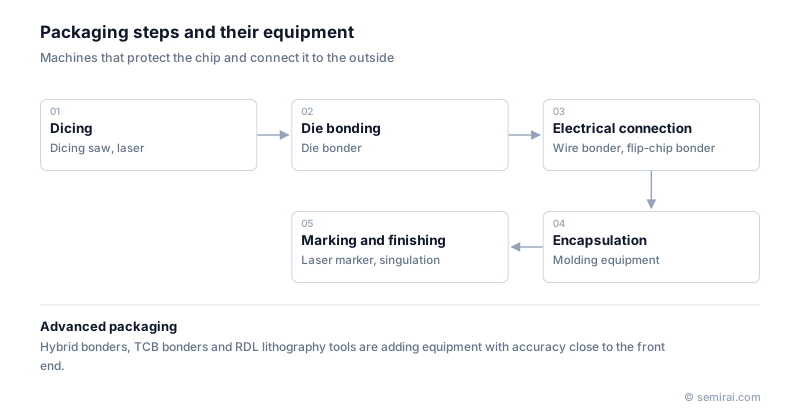
The main machine types, step by step
The conventional assembly line follows a fixed order. A back grinder first thins the wafer. A dicing machine then separates it into dies, either with a thin diamond blade, with a laser, or by stealth dicing, where a laser forms a modified layer inside the silicon and the wafer is split by stretching the tape. A die bonder picks each good die off the tape and places it on a lead frame or substrate with adhesive, film or solder.
The die is then connected. A wire bonder joins the chip's pads to the package leads with fine gold, copper or aluminium wire, while a flip-chip bonder turns the die over and joins it through bumps on its surface. A molding machine encapsulates the assembly in epoxy molding compound, either by transfer molding or by compression molding. Finally, laser markers, trim-and-form or singulation machines finish the package before electrical testing and shipment.
Why back-end equipment has become more demanding
Packaging used to be regarded as low-value work done after the real chip making was finished. Chiplets, 3D stacking, fan-out wafer-level packaging and high bandwidth memory have changed that. Hybrid bonders that join copper pads directly, thermocompression bonders for stacked memory, lithography tools for redistribution layers, through-silicon via etch and fill, and wafer bonders all need accuracy close to that of front-end tools.
As a result, the line between front end and back end is blurring. Foundries such as TSMC run their own advanced packaging lines, and suppliers of front-end equipment now sell tools for packaging as well.
Japanese companies involved
- DISCO and Tokyo Seimitsu (ACCRETECH) make dicing saws, laser dicing machines and wafer grinders, and Okamoto Machine Tool Works makes grinders and polishers used for wafer thinning.
- TOWA and Apic Yamada (Yamaha Robotics) build molding equipment, while Shinkawa (Yamaha Robotics), Kaijo and Toray Engineering make wire bonders, die bonders or flip-chip bonders.
- DISCO · Dicing, grinding and polishing equipment
- Tokyo Seimitsu (ACCRETECH) · Wafer probers, dicing and grinding machines, metrology
- Okamoto Machine Tool Works · Wafer polishers and grinders
- TOWA · Molding (encapsulation) equipment for chip packaging
- Apic Yamada (Yamaha Robotics) · Molding (encapsulation) equipment for semiconductor packages
- Kaijo · Wire bonders and ultrasonic cleaning systems
- Toray Engineering · Flip-chip bonders, die bonders and visual inspection systems
- Shinkawa (Yamaha Robotics) · Wire bonders and die bonders
FAQ
Is testing part of packaging?
Testing is usually counted as part of the back end but uses different equipment. Wafer probers and testers check dies before assembly, and handlers and testers check finished packages afterwards. Assembly and test are often done by the same outsourced assembly and test (OSAT) company.
Who operates packaging equipment?
Integrated device makers with their own back-end plants, outsourced assembly and test companies such as ASE and Amkor, and, for the most advanced packages, foundries and memory makers themselves. Most high-volume assembly capacity is in Asia.
Related pages
Sources
Last updated: November 2, 2026