Power Semiconductor
A power semiconductor is a semiconductor device designed to convert, control and rectify electric power rather than to process signals. Power MOSFETs, IGBTs, diodes and thyristors switch high voltages and large currents in inverters, motor drives, power supplies and chargers, and their losses largely decide how efficient those systems are.
Also called: power device, power semiconductor device
Diagram
How power devices differ from logic chips
A logic chip moves tiny currents at around one volt and is judged by speed and density. A power device acts as a switch that must block hundreds or thousands of volts when off, carry tens to hundreds of amperes when on, and change state thousands to millions of times a second. Its quality is measured by on-resistance (conduction loss), switching loss, breakdown voltage and how well it survives heat and faults.
To block high voltage, a power device has a thick, lightly doped drift layer, and current usually flows vertically from the top surface to the back of the chip. The die is therefore treated very differently from a logic die: the back side carries a metal electrode, and the chip is mounted on a substrate that removes heat.
Main device types
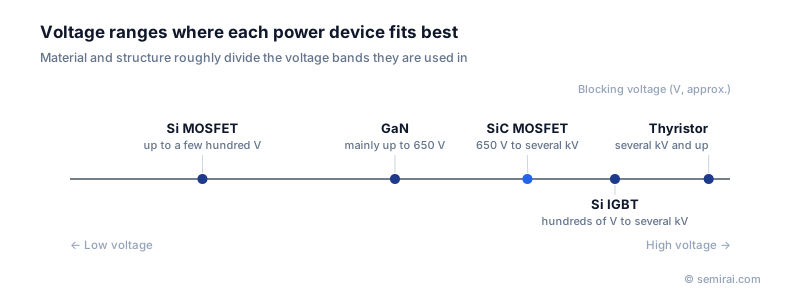
Power MOSFETs switch fast and dominate low and medium voltages, from phone chargers to server power supplies. IGBTs (insulated-gate bipolar transistors) combine a MOS gate with bipolar conduction and have long been the workhorse from roughly 600 V to several kilovolts in motor drives, trains and industrial equipment. Diodes, including Schottky barrier diodes, rectify current and carry it during switching dead times. Thyristors handle the very highest voltages and currents, such as in power transmission.
Material is the second axis. Silicon is cheap and mature. Silicon carbide (SiC) and gallium nitride (GaN), the wide bandgap materials, have a much higher breakdown field, so they cut losses and allow higher temperatures and frequencies. SiC MOSFETs have spread into electric-vehicle traction inverters and fast chargers, while GaN transistors are used in compact chargers and high-efficiency power supplies.
How power semiconductors are made
Power devices are usually made on separate lines from leading-edge logic, often on 150 mm or 200 mm wafers, and do not need the finest lithography. The critical steps are different: thick, uniform epitaxial drift layers, deep trenches, high-energy ion implantation, back-side thinning and metallisation, and for SiC, high-temperature implantation and activation annealing. SiC substrates are expensive and defect control strongly affects yield.
Japanese companies involved
- Mitsubishi Electric and Fuji Electric make IGBT and SiC power modules for industrial equipment, railways and vehicles.
- ROHM develops and manufactures SiC MOSFETs, SiC diodes and SiC wafers through its group company SiCrystal, and Toshiba makes power MOSFETs and IGBTs.
- Mitsubishi Electric (power devices) · IGBT and SiC power modules, RF and optical devices
- Fuji Electric (power semiconductors) · IGBT modules and SiC power devices
- ROHM · SiC and silicon power devices, analog ICs
- Toshiba Electronic Devices & Storage · Power MOSFETs, IGBTs and discrete semiconductors
- Tokyo Electron (TEL) · Coat/develop, etch and deposition equipment
- SCREEN Holdings · Wafer cleaning, coat/develop and inspection equipment
- Panasonic Connect · Plasma dicing, dry etching, plasma cleaning and flip chip bonding equipment
FAQ
Is a power semiconductor the same as a power IC?
Not exactly. Most power semiconductors are discrete devices or modules that do the actual switching. Power management ICs control voltage regulators and drive those switches; some integrate small power transistors, but high-power systems still use separate power devices.
Why do electric vehicles need so many power semiconductors?
The traction inverter turns battery DC into three-phase AC for the motor, an on-board charger converts grid AC to DC, and DC-DC converters feed the low-voltage systems. Every one of these conversions uses power switches and diodes, and their losses affect driving range and cooling.
Will SiC and GaN replace silicon?
Only partly. Silicon MOSFETs and IGBTs remain cheaper and are good enough for many uses. SiC is chosen where efficiency at high voltage matters most, and GaN where high frequency and small size matter, so the three materials are expected to coexist.
Comparisons
Related pages
Sources
Last updated: November 13, 2026