Temperature Cycle Test (TCT)
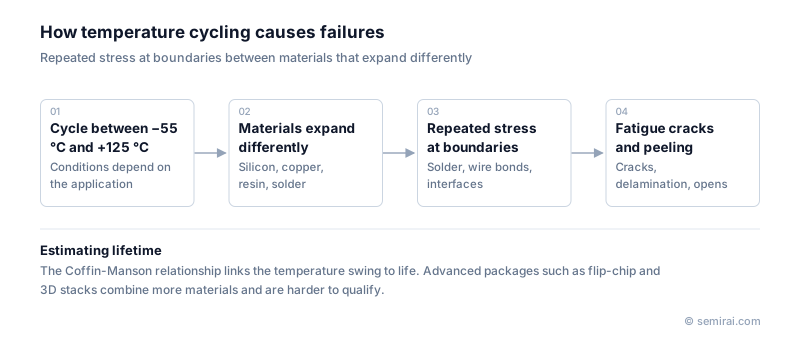
A temperature cycle test repeatedly moves semiconductor packages or assemblies between a low and a high temperature, for example -55 °C and +125 °C, for hundreds to thousands of cycles. It checks resistance to the mechanical stress caused by materials expanding at different rates, which leads to cracks, lifted bonds and delamination.
Also called: temperature cycling, TC test, thermal cycling
Diagram
What the test reveals
A package combines silicon, copper or alloy lead frames, mould compound, solder, die-attach material and organic or ceramic substrates, each with a different coefficient of thermal expansion. Every temperature change makes them expand or shrink by different amounts, and the joints between them take the strain. Over many cycles this fatigue cracks solder joints, breaks wire bonds at the heel, separates the die attach and causes delamination between the mould compound and the die or lead frame.
The target is therefore structural damage rather than the electrical wear-out examined by tests such as high-temperature operating life. Flip-chip bumps and underfill, large packages and silicon interposers, and stacked dies with through-silicon vias concentrate stress in more places, so advanced packages are harder to qualify.
Conditions and evaluation
JEDEC JESD22-A104 defines temperature ranges, dwell times and ramp rates. Parts are tested unpowered in an air chamber, usually with one chamber that ramps or two zones the parts shuttle between. Automotive qualification demands wider ranges and more cycles than consumer products.
Parts are checked electrically at intervals or monitored continuously for rising resistance, and scanning acoustic microscopy is used to look for delamination and cracks without opening the package. Failed parts are cross-sectioned to find where the crack started. The Coffin-Manson relationship links the temperature swing to the number of cycles to failure, allowing results to be translated to field conditions.
Japanese companies involved
- ESPEC makes environmental test chambers, including thermal shock and temperature cycling chambers, that are widely used for semiconductor reliability testing.
- ESPEC · Environmental and reliability test chambers
FAQ
How does temperature cycling differ from thermal shock?
Thermal shock changes temperature far faster, traditionally by moving parts between two liquid baths, as in JESD22-A106. Temperature cycling uses air and slower transitions closer to real use. Thermal shock exposes weaknesses quickly but stresses the package in a less realistic way.
Is temperature cycling the same as power cycling?
No. In temperature cycling the chamber changes the temperature of the whole part. In power cycling the device heats itself by passing current, creating steep gradients inside the package; it is the key test for power modules.
Is the test done on boards too?
Yes. Board-level temperature cycling mounts packages on test boards and monitors the solder joints, because the mismatch between package and board often limits the life of ball grid arrays.
Related pages
Sources
Last updated: November 2, 2026