Final Test
Final test is the electrical test of semiconductor chips after they have been packaged. Automated test equipment and a test handler check each unit's function, parameters and speed, often at controlled temperatures, to decide whether it can be shipped and which performance grade, or bin, it belongs to.
Also called: package test, FT, final test and sort
Diagram
Why test again after wafer test
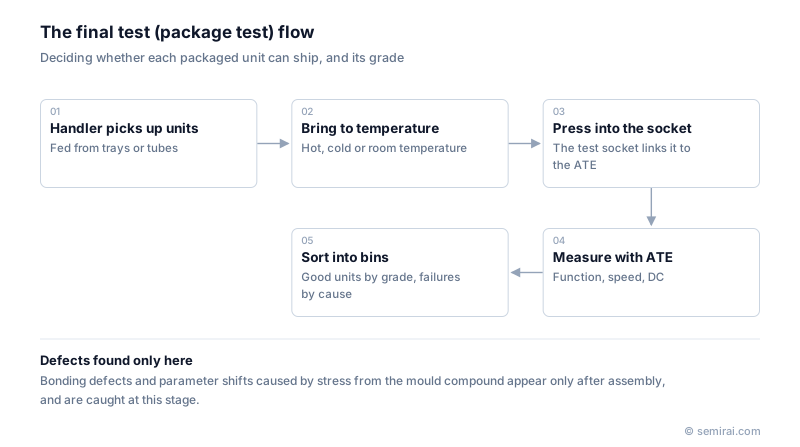
Wafer test shows that a die worked before assembly, but assembly can create new defects: a lifted wire bond or cracked bump, voids in the die attach, stress from the moulding compound that shifts sensitive analog parameters, or poor solder balls. The package also changes the thermal resistance and the electrical environment. Final test is the last check that the product works in the form the customer receives.
Final test can also do things that are hard through probe needles, such as supplying large currents, running at full speed through a well-matched socket, and testing at hot and cold temperatures with the device's actual heat path.
How it is done
A test handler picks packaged units from trays, tubes or strips, brings them to the test temperature and presses them into test sockets. The sockets connect the device leads or balls to the tester's load board. After the test program runs, the handler places each unit in an output tray according to its bin: good units by grade, failures by cause. The contact quality and signal integrity of the socket strongly affect the results.
Some products then go through burn-in to remove early failures and system-level test before shipping, depending on the reliability their market requires.
Binning and test cost
Chips of the same design differ slightly in maximum frequency and power. Final test measures this and sorts units into speed or power grades, which is how one design becomes several product models. Because test time is a direct cost, factories test several units per insertion (multi-site test) and reduce test items once production data show they are stable.
Japanese companies involved
- Advantest makes testers and test handlers used in final test, and ESPEC makes environmental chambers used to qualify packaged parts.
FAQ
How is a final test handler different from a wafer prober?
A prober holds a whole wafer on a chuck and steps a probe card across the dies. A handler moves individual packaged units into sockets. Pick-and-place, gravity-feed and strip handlers suit different package types and volumes.
Are final test and quality assurance the same?
No. Final test screens every unit. Quality assurance then retests a small sample from each lot, often under tighter conditions, to confirm that the screening worked before the lot is released.
Who performs final test?
Chip companies do it in their own back-end plants or send it to outsourced assembly and test (OSAT) companies, which often test right after packaging in the same factory.
Comparisons
Related pages
Sources
Last updated: November 2, 2026