Chemical Filter
A chemical filter is an air filter that removes contaminants present in air as gas molecules, known as airborne molecular contamination (AMC), by adsorption or chemical reaction. ULPA and HEPA filters remove particles but let molecules pass straight through, so chemical filters are used specifically for this job.
Also called: chemical air filter, AMC filter, gas-phase filter
Diagram
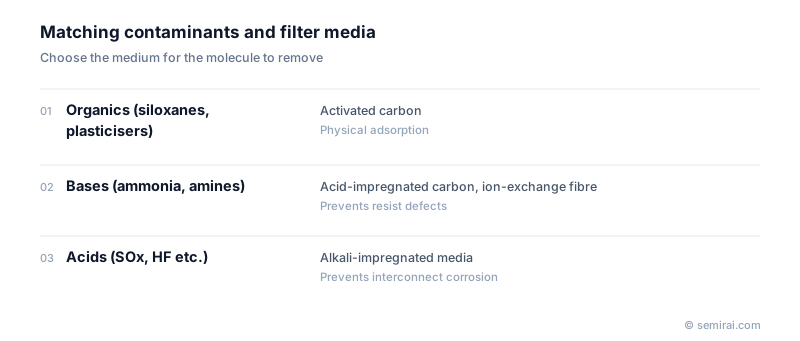
Matching media to contaminants
The filter medium is chosen for the contaminant. Activated carbon removes organics. Acid-impregnated carbon or ion-exchange fibres remove bases such as ammonia and amines. Alkali-impregnated media remove acids.
These are combined and installed in the air handlers that take in outside air, in ceiling fan filter units (FFUs), in wafer stockers and in EFEMs in front of tools.
Filters placed at the outside-air intake protect the whole fab from pollution such as sulphur oxides from outside, while filters in FFUs, stockers and EFEMs deal with contaminants released inside the cleanroom itself.
Breakthrough and replacement
Unlike a particle filter, a chemical filter has a limited adsorption capacity. As it fills, performance falls until contaminants start passing through, a point called breakthrough.
Fabs therefore measure contaminant concentrations upstream and downstream of the filter, or set replacement intervals by hours of use. Amines cause pattern defects in chemically amplified resists and acid gases corrode interconnects, so the contaminants to control are chosen to match each process area.
Japanese companies involved
- Nippon Muki and Nichias make chemical filters for semiconductor cleanrooms.
- Airtech Japan addresses molecular contamination in its cleanroom equipment, and Cambridge Filter Corporation makes HEPA and ULPA filters used alongside chemical filters.
- Nippon Muki · HEPA, ULPA and chemical filters and cleanroom equipment
- Cambridge Filter Corporation · HEPA and ULPA air filters for cleanrooms
- Airtech Japan · Cleanrooms, clean benches, air showers and FFUs
FAQ
How does a chemical filter differ from a ULPA filter?
A ULPA filter catches airborne particles in a mat of fibres and lets gas molecules through. A chemical filter removes molecules such as ammonia, amines, acid gases and organics by adsorption or reaction. Semiconductor fabs use both together.
What is breakthrough in a chemical filter?
Breakthrough is when the filter nears its capacity and the contaminant it should remove starts passing through. A particle filter shows clogging as a rising pressure drop, but a chemical filter gives no such sign, so replacement is managed by concentration measurements or hours of use.
Related pages
Sources
Last updated: November 1, 2026