Cleanroom
A cleanroom is an enclosed workspace in which the number of airborne particles, together with temperature, humidity and air pressure, is held within strict limits. Semiconductor fabs need them because a single particle far smaller than a human hair can bridge or break circuit lines only a few nanometres wide.
Also called: clean room, fab cleanroom
Diagram
How cleanliness is measured
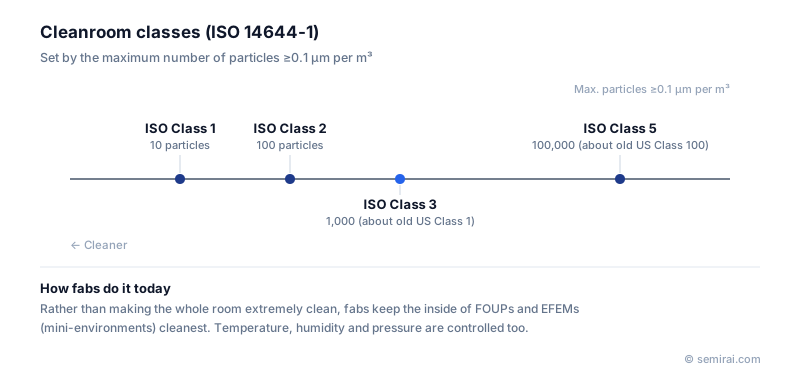
Cleanliness is graded by ISO 14644-1, which sets the maximum number of particles per cubic metre of air at given sizes. ISO Class 1 allows 10 particles of 0.1 µm or larger per cubic metre, and each class step up allows ten times more. Older documents still use the US Federal Standard 209E classes: ISO Class 3 roughly matches the old Class 1, and ISO Class 5 matches Class 100. A normal office is far dirtier, around ISO Class 8 or above.
Besides particles, the room controls temperature to a fraction of a degree in sensitive areas such as lithography, keeps relative humidity steady, and holds a slight positive pressure so that air always leaks outwards rather than in.
How a fab cleanroom works
Fan filter units (FFUs) with HEPA or ULPA filters cover the ceiling and push filtered air straight down. The air passes through a perforated raised floor, returns through wall shafts to the space above the ceiling and is filtered again. This one-way downflow carries particles from people and machines away from the wafers.
People are the largest source of particles, so workers wear full-body suits, gloves, masks and goggles. In modern 300 mm fabs, wafers are kept sealed in FOUPs and moved by overhead transport, and the cleanest air is concentrated inside the FOUPs and the tool front ends (the mini-environment approach) rather than across the whole room. This lowers the cost of building and running the space.
Japanese companies involved
- Daifuku and Murata Machinery build the automated material handling systems that move and store wafer carriers inside cleanrooms.
- Airtech Japan makes cleanroom equipment such as clean benches, air showers and fan filter units.
- Airtech Japan · Cleanrooms, clean benches, air showers and FFUs
- Daifuku · Cleanroom automated material handling systems (AMHS)
- Murata Machinery (Muratec) · Stockers and fab automation
FAQ
What cleanroom class does a semiconductor fab use?
It varies by area. Wafer processing bays in older fabs were built to very strict classes across the whole floor. Newer fabs often run the general room at a moderate class and keep the strictest conditions inside sealed carriers and tool front ends, where the wafer is actually exposed.
Why are fab cleanrooms so expensive?
They need thousands of filter units, very large volumes of conditioned air, vibration-resistant floors and tight control of temperature and humidity, all running around the clock. Floor space inside a fab cleanroom therefore costs far more per square metre than an ordinary factory.
Related pages
Sources
Last updated: November 2, 2026