Airborne Molecular Contamination (AMC)
Airborne molecular contamination (AMC) is contamination carried in cleanroom air as individual gas molecules rather than as particles. HEPA and ULPA filters stop particles but let molecules pass, so AMC needs its own controls. Concentrations are managed at parts per billion (ppb) or even parts per trillion (ppt).
Also called: molecular contamination, chemical contamination
Diagram
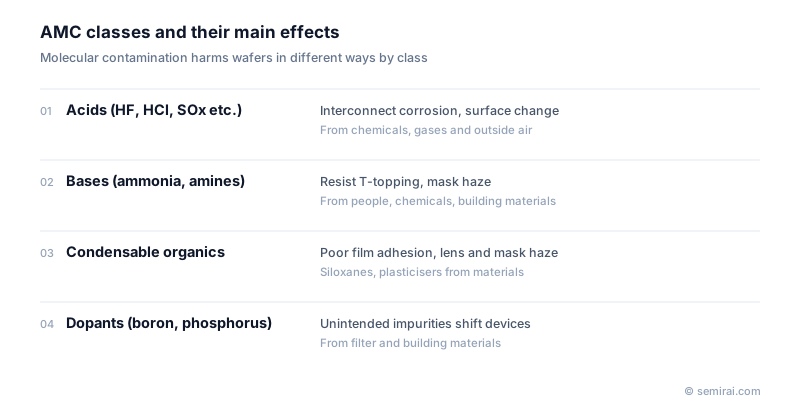
The four classes of AMC
AMC is usually grouped into four classes. Acids include hydrogen fluoride, hydrogen chloride and sulphur oxides. Bases include ammonia and amines. Condensable organics include siloxanes and plasticisers that stick to surfaces. Dopants include boron and phosphorus compounds that can enter silicon as unintended impurities.
The sources are varied: outside air drawn in by the air handlers, chemicals and gases used in the fab, people, building and flooring materials, piping components and even the materials of the filters themselves. Because the contaminants are molecules, they also travel with the air inside wafer carriers and tools.
How AMC damages wafers and masks
Each class causes a different problem. Bases neutralise the photo-generated acid in chemically amplified resists, leaving an undissolved cap on top of the pattern known as T-topping. Acids corrode metal interconnects. Organics adsorb on wafers and lens surfaces, weaken film adhesion and contribute to haze on photomasks and pellicles. Dopants shift transistor characteristics.
Fabs fight AMC with chemical filters that use activated carbon or ion-exchange media, nitrogen purging of FOUPs and tool interiors, and limits on the waiting time between process steps (queue time, or Q-time) so that exposed surfaces spend less time in the air.
Japanese companies involved
- Nippon Muki supplies chemical filters as well as HEPA and ULPA filters for semiconductor cleanrooms.
- Airtech Japan builds cleanrooms and cleanroom equipment, where molecular contamination control is part of the design.
- Cambridge Filter Corporation · HEPA and ULPA air filters for cleanrooms
- Nippon Muki · HEPA, ULPA and chemical filters and cleanroom equipment
- Airtech Japan · Cleanrooms, clean benches, air showers and FFUs
FAQ
How is AMC different from particles?
Particles are tiny solid or liquid specks that fibrous HEPA and ULPA filters capture. AMC consists of single molecules, far too small for those filters. It is removed by adsorption or chemical reaction in chemical filters, and it is measured with gas analysers rather than particle counters.
Why are ammonia and amines such a problem?
Chemically amplified resists form patterns through reactions driven by acid generated during exposure. Even traces of ammonia or amines in the air can diffuse into the resist surface and neutralise that acid, causing T-topping and line-width errors. Bases also contribute to haze growth on photomasks.
Related pages
Sources
Last updated: November 2, 2026