Chemically Amplified Resist (CAR)
A chemically amplified resist (CAR) is a photoresist containing a photoacid generator (PAG) that releases acid when exposed; the acid then acts as a catalyst for a chain of reactions in the surrounding resin. Because one acid molecule acts many times, patterns can be formed with little light. It was developed at IBM in the early 1980s.
Also called: CAR, chemically amplified photoresist
Diagram
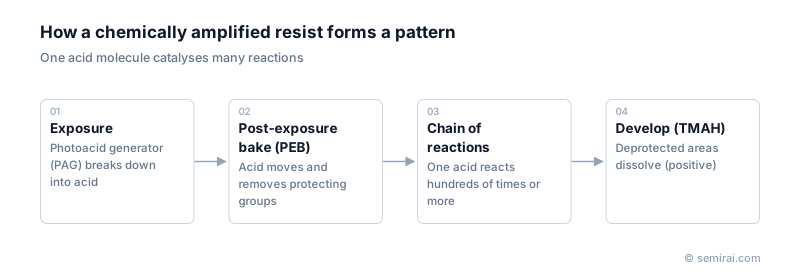
How chemical amplification works
Exposure decomposes the PAG and creates acid, but no pattern exists yet. During the post-exposure bake (PEB), the acid moves a short distance through the resin and removes protecting groups that kept the resin insoluble in developer. The deprotected regions dissolve in alkaline TMAH developer, giving a positive pattern.
The acid is not consumed, so a single acid molecule can trigger hundreds of deprotection reactions or more. Older resists needed one photon per reaction; chemical amplification multiplies the effect of each photon, raising sensitivity sharply.
From KrF to EUV, and the drawbacks
CARs were put into production for KrF (248 nm) lithography, where novolac i-line resists were too absorbing and not sensitive enough. They remain the mainstream for ArF, ArF immersion and EUV.
Their weaknesses are blur, because acid diffusion smears the pattern edge, and sensitivity to airborne bases such as amines, which neutralise acid at the surface and cause T-topping. In EUV, few photons are absorbed, so random variation in acid generation causes line roughness and stochastic defects. This has driven work on alternatives such as metal oxide resists.
Japanese companies involved
- JSR, Tokyo Ohka Kogyo (TOK), Shin-Etsu Chemical and Sumitomo Chemical develop and supply chemically amplified photoresists for KrF, ArF and EUV lithography.
- JSR · Photoresists and semiconductor materials
- Tokyo Ohka Kogyo (TOK) · Photoresists and high-purity process chemicals
- Shin-Etsu Chemical · Silicon wafers, photoresists and photomask blanks
- Sumitomo Chemical · Photoresists and semiconductor process chemicals
FAQ
What is T-topping?
It is a defect in which the top of a positive CAR pattern fails to dissolve, giving a T-shaped cross-section. Airborne amines or other bases enter the resist surface between exposure and bake and neutralise the acid there. Chemical air filters in the litho area and protective top-coat layers prevent it.
Why is acid diffusion both useful and harmful?
Some diffusion is needed so that acid reaches enough protecting groups and smooths out shot noise. Too much diffusion carries acid into unexposed areas and blurs the edge, limiting resolution. Resist designers add base quenchers and bulky acids to set the diffusion length to a few nanometres.
Comparisons
Related pages
- Photoresist
- Post-Exposure Bake (PEB)
- Metal Oxide Resist (MOR)
- Line Edge Roughness (LER)
- Stochastic Effects (EUV)
- Airborne Molecular Contamination (AMC)
- Chemical Filter
- PFAS Regulation
- Photoresists
- DUV lithography systems
- JSR ArF immersion photoresists
- Shin-Etsu Chemical Photoresists (SEPR, SAIL, and other series)
- Tokyo Ohka Kogyo (TOK) OFPR series (g-line positive resists)
- Canon FPA-3030EX6
Sources
Last updated: November 12, 2026