Equipment Availability and Utilization
Equipment availability and utilization measure how much of the total time a tool is able to run and how much it actually spends on production. In a fab, where tools are very expensive, these measures largely decide the return on equipment investment. Their exact meaning depends on what is counted, so definitions must be agreed.
Also called: uptime, utilization, operating rate, tool availability
Diagram
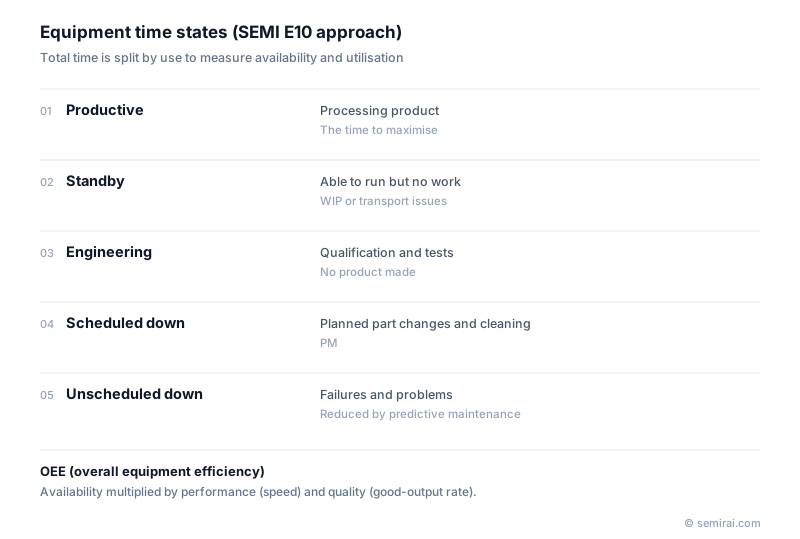
SEMI E10 time states
The SEMI E10 standard divides total time into states. Productive time is when the tool processes product. Standby is when it is able to run but has no work. Engineering time is used for process development and qualification. Scheduled downtime covers planned maintenance, unscheduled downtime covers failures, and non-scheduled time is when the tool is not planned to run at all.
From these states, availability (uptime) is the share of time the tool is in a condition to run, and utilization is the share in which it actually runs product. Splitting downtime by cause shows where improvement is possible.
OEE and improvement
Overall equipment efficiency (OEE) multiplies availability by performance (actual speed versus ideal speed) and quality (good output versus total output). A tool that never stops can still lose capacity if it runs slowly or makes defects, and OEE captures this.
Fabs raise availability with predictive maintenance that spots failures early, shorter maintenance procedures and better spare-part logistics. They raise utilization by reducing standby, which usually means better dispatching and transport so that tools are not waiting for wafers.
Japanese companies involved
- Tokyo Electron and other Japanese equipment makers report tool performance data that fabs use to track availability and plan maintenance.
- Tokyo Electron (TEL) · Coat/develop, etch and deposition equipment
FAQ
What is the difference between availability and utilization?
Availability counts the time a tool is able to run, whether or not it has work. Utilization counts the time it actually processes product. A tool can be highly available but poorly utilised if wafers do not reach it.
What is the difference between utilization and OEE?
Utilization looks only at time. OEE also includes speed losses and quality losses, multiplying availability, performance and quality, so it shows the effective capacity a tool delivers.
Related pages
Sources
Last updated: November 1, 2026