Electrostatic Chuck (ESC)
An electrostatic chuck (ESC) is a ceramic stage that clamps a wafer by electrostatic force, using electrodes buried under a thin dielectric layer. Because vacuum chucks cannot work in a vacuum chamber, the ESC is the standard way to hold wafers in etch, CVD, PVD and ion implant tools.
Also called: ESC, e-chuck
Diagram
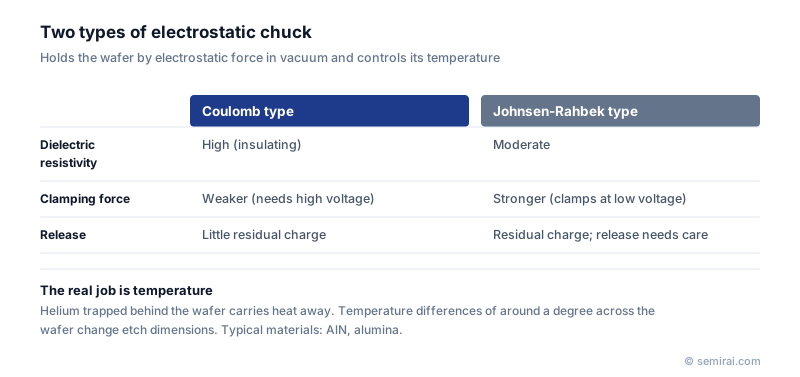
Coulomb and Johnsen-Rahbek types
A Coulomb chuck uses a highly insulating dielectric such as alumina. The wafer and electrode act like the two plates of a capacitor. It releases the wafer quickly when the voltage is removed, but needs a relatively high voltage for a given clamping force.
A Johnsen-Rahbek (JR) chuck uses a dielectric of moderate resistivity, often aluminium nitride (AlN). A small leakage current lets charge gather right at the contact surface, which narrows the effective gap and gives a much stronger force at lower voltage. The trade-offs are stronger temperature dependence and residual charge that can make the wafer stick after release.
Temperature control is the real job
Plasma pours heat into the wafer. The ESC removes it through coolant channels in its base, and through helium gas fed at a few to tens of torr into the small gap between the wafer back and the chuck surface. The clamping force is what keeps that helium from leaking away.
Etch rate and selectivity depend strongly on temperature, so even a difference of around a degree across the wafer can change feature sizes near the edge. Leading-edge chucks therefore split the heater into several concentric zones that are controlled separately. The surface carries tiny raised dots that reduce contact area and particles on the wafer back.
Japanese companies involved
- NGK Insulators, TOTO and Shinko Electric Industries make ceramic electrostatic chucks for wafer processing equipment.
- Creative Technology makes electrostatic chucks and the power supplies that drive them.
- Shinko Electric Industries · FC-BGA package substrates and lead frames
- NGK Corporation · Electrostatic chucks, ceramic heaters and susceptors
- TOTO · Electrostatic chucks and fine ceramic parts
- Creative Technology · Electrostatic chucks and chuck power supplies
- Kyocera · Package substrates and ceramic components
FAQ
Why can't a vacuum chuck be used in a plasma chamber?
A vacuum chuck holds the wafer by the pressure difference between the room and a vacuum under the wafer. Inside a vacuum chamber there is no such difference. Electrostatic force works at any pressure and also lets the tool trap helium behind the wafer for cooling.
Is an electrostatic chuck a consumable part?
Partly. Its surface is exposed to plasma and gradually wears or changes, which affects clamping and particles. Chucks are replaced or sent for refurbishment, such as resurfacing, at intervals set by the fab, so they appear in equipment running costs.
Related pages
Sources
Last updated: November 2, 2026