Cleanroom Class (ISO 14644-1)
A cleanroom class is a grade that states how clean the air in a cleanroom is, defined by the maximum number of particles at or above a given size in one cubic metre of air. ISO 14644-1 defines nine classes, ISO Class 1 to ISO Class 9; the smaller the number, the cleaner the air.
Also called: cleanliness class, ISO class
Diagram
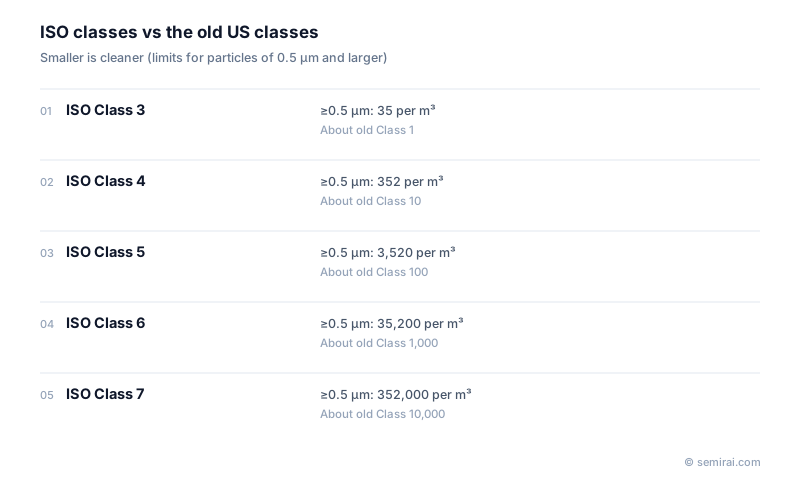
How the classes are defined
For ISO Class N, the limit for particles of 0.1 µm and larger is 10 to the power N per cubic metre. ISO Class 5, for example, allows 100,000 particles of 0.1 µm or larger and 3,520 particles of 0.5 µm or larger per cubic metre. Japan's JIS B 9920 follows the same approach.
Before ISO 14644-1, the US Federal Standard 209E was widely used. Its classes counted particles of 0.5 µm and larger per cubic foot, so Class 100 corresponds roughly to ISO Class 5, Class 10 to ISO Class 4 and Class 1 to ISO Class 3. Engineers on fab floors still use these older names.
How clean a fab really is
The places where wafers are exposed need the highest cleanliness. Keeping a whole building at an extremely clean class would make air handling very expensive, so modern fabs carry wafers in sealed FOUPs and keep only the equipment front-end modules (EFEMs) and tool interiors extremely clean. The room itself can then run at a somewhat less strict class, an approach called a mini-environment.
Japanese companies involved
- Airtech Japan designs cleanrooms and supplies cleanroom equipment such as clean benches, air showers and fan filter units.
- Cambridge Filter Corporation and Nippon Muki make the HEPA and ULPA filters that cleanroom classes depend on.
- Airtech Japan · Cleanrooms, clean benches, air showers and FFUs
- Cambridge Filter Corporation · HEPA and ULPA air filters for cleanrooms
- Nippon Muki · HEPA, ULPA and chemical filters and cleanroom equipment
- Hitachi High-Tech · CD-SEM metrology, defect inspection and etch systems
FAQ
Is ISO Class 5 the same as the old Class 100?
They are roughly equivalent. Class 100 allowed 100 particles of 0.5 µm or larger per cubic foot, which works out to about 3,520 per cubic metre, the same as the ISO Class 5 limit at 0.5 µm. The two standards differ in details such as which particle sizes are counted and how samples are taken.
What class does a semiconductor fab use?
It varies by location. The inside of tools and FOUPs, where wafers are exposed, is kept at around ISO Class 1 to 3, while the rooms where people work usually run at a less strict class. Fabs also check classes regularly with particle counters, and the measurement method is itself set out in ISO 14644-1.
Related pages
Sources
Last updated: November 2, 2026