Fan Filter Unit (FFU)
A fan filter unit (FFU) combines a fan and a high-efficiency air filter, such as a HEPA or ULPA filter, in one box. FFUs are mounted in a grid across the cleanroom ceiling and blow filtered air straight down, creating the clean air in which wafers are processed.
Also called: FFU
Diagram
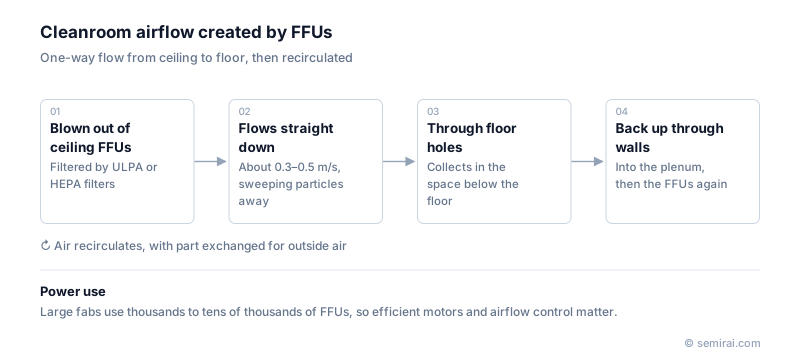
How FFUs create clean air
HEPA filters remove at least 99.97% of 0.3 µm particles. ULPA filters go further, removing at least 99.999% of smaller particles around 0.1 to 0.2 µm. Air leaves the FFUs at roughly 0.3 to 0.5 m/s and moves downwards in one direction, sweeping particles from people and tools towards the floor.
It passes through the perforated floor into the space below, returns up through wall shafts to the plenum above the ceiling, and is drawn back through the FFUs. A portion of the air is exchanged with conditioned outside air.
Advantages and energy use
Each FFU can be set to its own airflow, and units can be replaced or added one at a time, which makes the system flexible. A large fab, however, uses thousands of units, so fan power is a major part of energy use. Efficient EC motors and control that lowers airflow where full flow is not needed help reduce it.
Small FFUs are also built into tool front ends (EFEMs) and other mini-environments to keep the air immediately around the wafer especially clean. Chemical filters can be added to remove gaseous contamination such as organics and acids that particle filters cannot catch.
Japanese companies involved
- Airtech Japan makes fan filter units and other cleanroom equipment.
- Nippon Muki and Cambridge Filter Corporation make HEPA, ULPA and chemical filters for cleanrooms.
- Airtech Japan · Cleanrooms, clean benches, air showers and FFUs
- Cambridge Filter Corporation · HEPA and ULPA air filters for cleanrooms
- Nippon Muki · HEPA, ULPA and chemical filters and cleanroom equipment
FAQ
What is the difference between HEPA and ULPA filters?
Both trap particles in a dense fibre mat. HEPA filters are rated at 99.97% or better for 0.3 µm particles; ULPA filters are rated at 99.999% or better for smaller particles of about 0.1 to 0.2 µm. Leading-edge fabs mainly use ULPA filters in process areas.
How often are FFU filters replaced?
Filters are replaced when airflow or pressure drop shows they are loaded, or when leak tests find damage. In a well-run fab, where most air is recirculated and already clean, ceiling filters can last for years.
Related pages
Sources
Last updated: November 2, 2026