Mini-environment
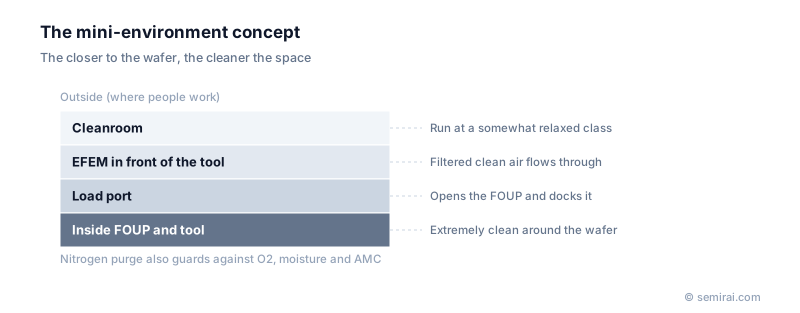
A mini-environment is the concept, and the equipment, of enclosing only the small spaces where wafers sit or move and keeping those spaces especially clean, instead of making the whole cleanroom extremely clean. In a semiconductor fab, the FOUP that holds wafers, the EFEM in front of a tool and the load port that opens the FOUP form the mini-environment.
Also called: local clean environment, SMIF
Diagram
Why fabs moved to mini-environments
Older fabs carried wafers in open cassettes, so the entire room had to be kept at a very high cleanliness. Holding a large room with people and materials moving through it at that level means pushing huge volumes of air through high-performance filters all the time, and the air-handling plant and electricity bills become very large.
In the 1980s Hewlett-Packard and others proposed SMIF (standard mechanical interface), which carried wafers in small sealed boxes. That idea led directly to the FOUPs and EFEMs used in today's 300 mm fabs.
What it achieves
With a mini-environment, the room can run at a somewhat relaxed class while the space around the wafer is kept extremely clean. Cleanliness at the wafer improves while construction and running costs fall. Separating people from wafers also removes the largest source of particles.
Fabs now go further and fill FOUPs and EFEMs with nitrogen, protecting wafers not only from particles but also from oxygen, moisture and molecular contaminants.
Japanese companies involved
- Sinfonia Technology and Hirata Corporation make load ports and EFEMs, and TDK also makes load ports for 300 mm fabs.
- RORZE makes wafer handling robots and EFEMs, and Daifuku supplies the automated material handling systems that move FOUPs between tools.
- RORZE · Wafer handling robots and sorters
- Sinfonia Technology · Load ports, EFEMs and wafer transfer robots
- TDK · Magnetic sensors, piezoelectric devices and passive components
- Hirata Corporation · EFEMs, load ports and wafer transfer units
- Daifuku · Cleanroom automated material handling systems (AMHS)
FAQ
How does a mini-environment differ from a cleanroom?
A cleanroom keeps the air of an entire room clean with filters. A mini-environment is a small enclosed space inside that cleanroom, around the wafer, held at an even higher cleanliness. Fabs combine the two to balance cleanliness against cost.
What is nitrogen purging of FOUPs and EFEMs?
It means replacing the air inside them with nitrogen. This stops oxygen, moisture and molecular contaminants from growing native oxide, corroding metal or depositing on the wafer surface. It matters most when wafers wait a long time between steps or when reactive materials are exposed.
Related pages
Sources
Last updated: November 13, 2026